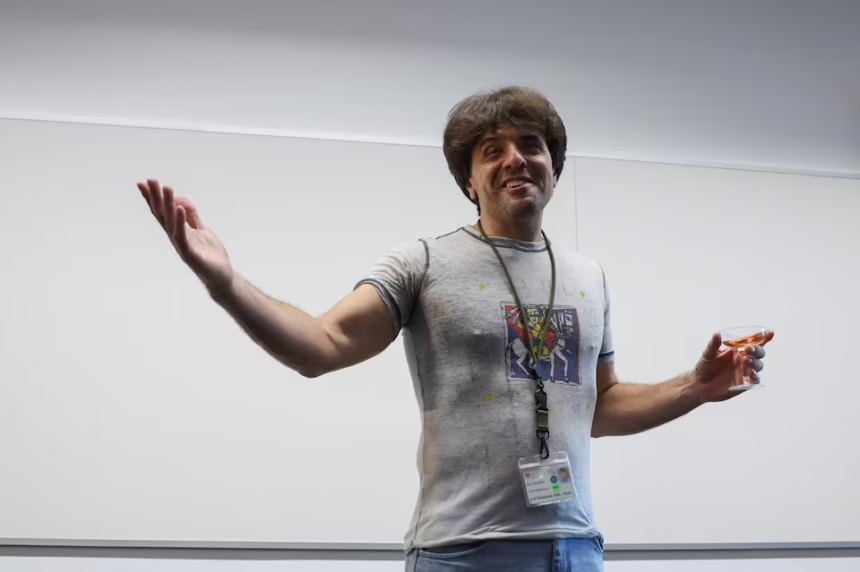
American Karl Deisseroth and Germans Peter Hegemann and Georg Nagel were awarded the 2026 Nobel Prize in Physiology or Medicine on Monday for discovering optogenetics, a technology that utilizes light to regulate individual nerve cells in the brain.
The Nobel Assembly of Sweden’s Karolinska Institutet recognized Deisseroth, 54, Hegemann, 71, and Nagel, 73, for their “discoveries concerning light-gated ion channels and optogenetics.”
Quick Fact
| Detail | Information |
|---|---|
| What happened | Three researchers won the 2026 Nobel Prize in Physiology or Medicine for discoveries behind optogenetics. |
| Who | Karl Deisseroth, Peter Hegemann, and Georg Nagel |
| Discovery | Light gated ion channels and optogenetics |
| Location | Stockholm, Sweden |
| Year | 2026 |
| Why it matters | Optogenetics lets scientists control specific nerve cells using light. |
According to Thomas Perlmann, Secretary-General of the Nobel Assembly at Karolinska Institutet, this approach allows for the activation or inhibition of specific nerve cells in a living brain.
According to Anna Wedell, a genetics professor and member of the Nobel Committee for Physiology or Medicine, neuroscience has entered a new age, but this is only the beginning.
“For the first time, we can begin to understand how the brain processes information and how different neurons interact throughout the brain,” she added.
Nobel Winners React to Surprise Calls
Deisseroth reported being awake in the early hours when he received a call from Stockholm.
As a nite owl, I hadn’t fallen asleep yet, and now I don’t believe I’ll be able to sleep for a long,” he added.
Hegemann was surprised to get a call from a Sweden-based number, stating, “It’s unbelievable when you get this message.”.
Nagel was sitting on a terrace “in a nice little village outside Naples” when the call came in.
BREAKTHROUGH FROM ALGAE
Deisseroth was preparing to be a neurosurgeon when he came across folks he couldn’t treat at a mental clinic. Witnessing pain without treatment led to a career-defining question: why does the brain function differently in different individuals?
The solution would come from an unlikely source: an alga and two German scientists motivated by a similar level of curiosity.
Hegemann, who was attracted by adventure and undiscovered area, began researching how the alga Chlamydomonas responds to light in half a millisecond in the early 1990s.
Discovery of Optogenetics Changed Neuroscience
He proposed that a single protein might collect light and operate as an ion channel, and asked Nagel to test it.
In response to Hegemann’s first request, Nagel experimented with introducing Chlamydomonas genes into frog eggs and finding channelrhodopsin-2, a light-sensitive ion channel.
In 2003, Nagel and Hegemann discovered that the protein could be injected into human cells to create electrical impulses using light.
Deisseroth demonstrated the approach in rat nerve cells in 2005, and the process was dubbed optogenetics in 2006.
Optogenetics Offers Insights Into Brain Disorders
The three laureates’ study is now revealing insights into brain problems.
Deisseroth utilized optogenetics to regulate mouse whisker motions by stimulating specific nerve cells in the motor cortex. He utilized light to awaken sleeping mice, proving that certain nerve cells regulate alertness.
“There are mouse models of dementia, epilepsy, and addiction,” Wedell explained. “By understanding which cells are active in these diseases in mice, we can understand where to look humans.”
Optogenetics Advances Vision and Hearing Treatments
Researchers are using the approach to restore eyesight to persons with retinitis pigmentosa, a degenerative eye illness, by injecting a light-sensitive protein into the retina.
Opogenetics may improve cochlear implants by providing more accurate stimulation of the auditory nerve than existing electrical devices.
According to Paul Bresge, CEO of Ray Therapeutics, a US biotechnology firm researching a therapeutic for retinitis pigmentosa, patients can access light simply by opening their eyes. “So it makes a lot of sense potential therapy.”