The latest USA vs. Venezuela crisis had been changed the political and diplomatic relations between the two countries.
Following the US military operation that resulted in Nicolás Maduro’s capture, Venezuela appointed a president, introduced major oil reforms, and faced international scrutiny. The developments had debate over international law, regional stability, and the future of Venezuela’s government.
International Condemnation and Reactions
Governments, legal professionals, and international organizations from all around the world criticized the US operation. UN officials and experts in international law said that the military intervention went against the UN Charter’s tenets.
There were differing opinions among Venezuelans. Many Venezuelans living abroad applauded Maduro’s arrest, viewing it as a watershed moment for the nation’s political destiny, while protests were recorded in a number of locations.
Immediate Political Changes
Following the operation, the Venezuelan government remained in place under new leadership.
Delcy Rodríguez Becomes Acting President
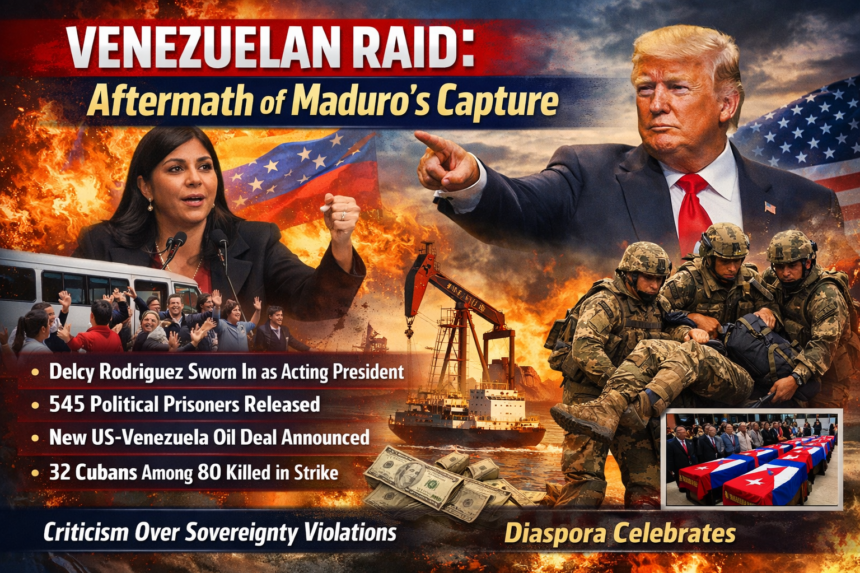
On January 5, 2026, Delcy Rodriguez took over as interim president. Her appointment coincided with the announcement by the authorities of the release of a number of political prisoners and international inmates.
545 of the estimated 800 inmates who had been detained prior to January had been freed by February 24, according to government reports. Legislation that would provide legal protection to political prisoners held between 1999 and 2026 was also adopted by lawmakers in February.
Diplomatic and Oil Developments
The political transition was accompanied by significant changes in Venezuela’s energy sector.
A 50 million barrel oil agreement was announced, with $300 million reportedly received by January 20. Later, on January 29, Rodríguez signed legislation allowing private companies to take a greater role in oil production and sales.
The United States also lifted sanctions on Venezuelan oil and issued new trading licenses. According to US Energy Secretary Chris Wright, oil sales exceeded $1 billion following Maduro’s capture, with projections reaching $5 billion in the coming months.
These decisions marked an important shift in the economic dimension of USA vs. Venezuela relations.
Venezuelan Leadership and Political Controversies
For years, Nicolás Maduro’s leadership had drawn condemnation from throughout the world.
A protracted political crisis resulted from 45 nations rejecting his 2018 election. Allegations of fraud were in the 2024 presidential election, where opposition candidate Edmundo González declared victory.
The political conflict in Venezuela was further complicated when the administration acknowledged González as the country’s president-election.
Cilia Flores' Role
Cilia Flores, Maduro’s wife and a senior figure within the Chavista movement, held several influential government positions over the years.
She also faced sanctions imposed by the United States, Canada, and Colombia related to travel restrictions and corruption allegations.
Military Capture and Strikes
Higuerote Airport and Fort Tiuna were among the important sites that were the focus of the US military campaign.
The mission involved over 150 US aircraft, including helicopters, drones, F22 Raptors, and B1 bombers. The operation that resulted in Maduro’s detention was executed by Delta Force members with CIA assistance.
Later, Maduro, Flores, and a number of co-defendants in drug-related crimes were moved to the Southern District of New York, where they entered not guilty pleas.
At least 47 Venezuelan soldiers were killed during the attacks, according to officials, while 32 Cuban servicemen were injured. There were also a few civilian deaths recorded. Seven US military men were hurt but recovered.
The operation became one of the most significant moments in recent USA vs. Venezuela tensions.
Why This Matters
Both Venezuela’s internal politics and its foreign relations have changed as a result of the events.
Important advancements consist of:
- a change of leadership within Venezuela.
- Significant changes impacting the nation’s energy sector.
- US sanctions policy changes.
- Rekindled worldwide discussion over international law and military action.
- persistent doubt about the political future of Venezuela.
What Happens Next?
Venezuela’s interim administration is expected to continue implementing political and economic reforms while seeking broader international recognition.
At the same time, legal proceedings involving Maduro and other defendants are expected to continue in the United States. International observers will also closely watch whether diplomatic relations between Washington and Caracas continue to evolve in the months ahead.
In conclusion
The latest developments have created one of the most significant turning points in modern USA vs. Venezuela relations.
While leadership changes and oil sector reforms are already underway, the long term political, legal, and diplomatic consequences remain uncertain. The coming months will likely determine whether these events lead to lasting stability or renewed regional tensions.
Frequently Asked Questions
What is the focus of the latest USA vs. Venezuela developments?
The latest events include a US military operation, political leadership changes in Venezuela, international criticism, and major reforms affecting the country’s oil industry.
Who became Venezuela's acting president?
Delcy Rodríguez assumed the role of acting president on January 5, 2026, following the military operation.
What changes were made to Venezuela's oil sector?
New legislation allowed private companies to participate in oil production and sales, while the United States lifted sanctions on Venezuelan oil exports.
Why did the operation receive international criticism?
UN officials and international law experts argued that the military action violated the principles of the UN Charter.
What happens next?
Legal proceedings involving Nicolás Maduro are expected to continue, while Venezuela’s interim government pursues political and economic reforms amid ongoing international attention.