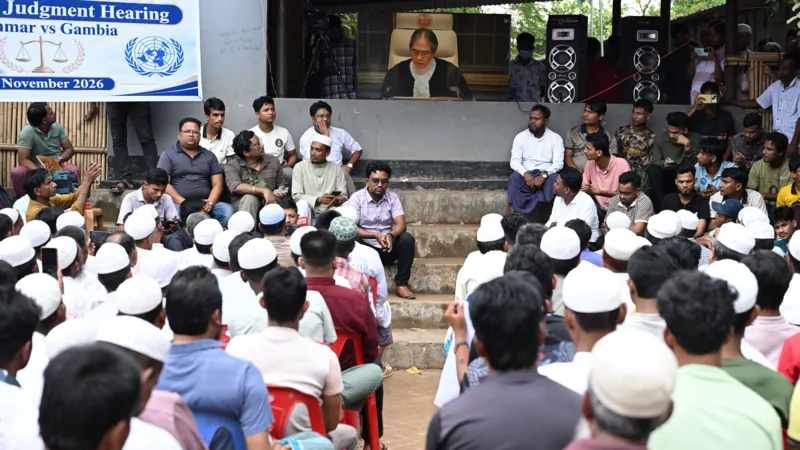
The International Court of Justice (ICJ) has declared that Myanmar committed genocide against its Rohingya minority.
The decision is the first time an international court has ever determined that a state has committed genocide.
The head of the UN’s highest court, Yuji Iwasawa, claimed that Myanmar engaged in “extensive destruction of evidence” to conceal its crimes and had the “intention to destroy” a significant portion of the Rohingya community.
Thousands of Rohingya were slaughtered in a military crackdown in 2017, and over 700,000 were forced to escape the Buddhist-majority country of Myanmar, formerly known as Burma.
Quick Fact
| Key Fact | Details |
|---|---|
| Country | Myanmar |
| Victims | Rohingya Muslim minority |
| Ruling | ICJ found Myanmar responsible for genocide |
| Verdict | 9 votes to 6 |
| Key Action | UK ordered Myanmar's defence attaché expelled |
| US Response | Studying the court's decision |
| Reparations | Myanmar ordered to provide proportionate compensation |
ICJ Rules Myanmar Committed Genocide
On Thursday, the court determined that “genocidal intent is the only reasonable inference that can be drawn from the evidence” it had observed.
A panel of judges from all across the world reached the decision by a majority of nine votes to six. The majority of the ICJ also concluded that Myanmar had broken a number of other provisions of the 1948 Genocide Convention.
The Gambia’s lawsuit focused on purported “clearance operations” that were started in Rakhine State in 2017, where a large portion of the Rohingya Muslim minority lived.
ICJ Details Myanmar's Rohingya Atrocities
According to Iwasawa, the military in Myanmar committed “extreme violence” against children, “widespread” sexual violence, “indiscriminate” deaths, the execution of males, and the intentional burning of Rohingya homes.
He claimed that when the Rohingya were escaping to Bangladesh, the military had also attacked them.
He went on to say that Myanmar had committed “extensive destruction of evidence” by burning or discarding remains, burning and demolishing cleared locations, and failing to bring those responsible for the violent acts to justice.
Myanmar has continuously denied committing genocide against the Rohingya, claiming that in reaction to the Arsa attacks, military actions had targeted militant or insurgent threats.
ICJ Orders Myanmar to Pay Reparations
Ko Ko Hlaing, a government official, told the International Court of Justice in January that the nation “was not obliged to remain idle and allow terrorists to have free reign.” He declared he had “no comment” after the verdict on Thursday.
The International Court of Justice (ICJ) examined the broader treatment of Rohingya prior to the clearance operation and concluded that measures such as restricting married couples to have two children were discriminatory and intended to undermine their rights.
Although no exact amount could be ascertained, it stated that Myanmar was required to make proportionate compensation.
Human rights organizations and Rohingya communities applauded the court’s ruling.
“Long-awaited recognition of the suffering the Rohingya have endured” is how Human Rights Watch described the decision.
The “suffering, misery and humiliation” imposed upon the Rohingya people, according to UN human rights chief Volker Türk, is a “stain on the conscience of humanity”. The court’s ruling “must now translate into real action,” he continued.
In order to hold the Myanmar government accountable for genocide, the court had to find not only that horrible crimes had been perpetrated but also that state authorities or armed forces had the intention of eradicating the group whole or in part.
US and UK Respond to Myanmar Genocide Ruling
“The proper interpretation” of the Genocide Convention and “preventing politicization” of the International Criminal Court are of “paramount importance,” according to a US State Department official. “We are studying the decision to fully assess its implications,” they stated.
They said that the US is the “leading donor for the Rohingya” and expressed their “grave concerns over the continued abuses human rights against Rohingya Muslims and members of other minority groups.”
Following the decision on Thursday, UK Foreign Secretary Ed Miliband announced that he was calling Myanmar’s charge d’affaires and that the government was ordering the expulsion of the country’s defense attaché.