
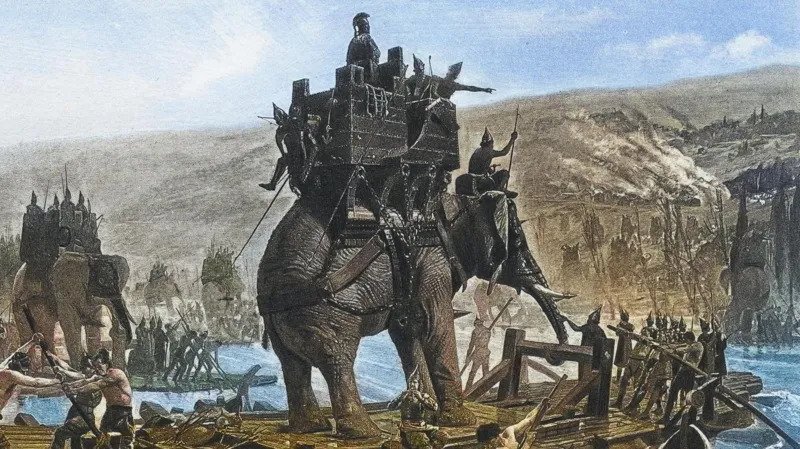
Archaeologists in southern Spain may have uncovered the first physical evidence of Hannibal’s legendary war elephants. A single elephant foot bone discovered near Cordoba hints that these massive animals once marched through ancient Europe.
Clues from History
Hannibal, the famous Carthaginian general, fought three Punic wars between 264 and 146 BCE, aiming to control the Mediterranean. Historical accounts describe how he brought soldiers and war elephants from Carthage, traveling across Spain and France to invade Italy. In 218 BCE, he famously crossed the Alps with 37 elephants.
The bone was unearthed at a site called Colina de los Quemados during an Iron Age excavation led by Professor Rafael M. Martínez Sánchez. It lay beneath a collapsed wall, alongside coins, ceramics, and artillery discovered in 2020. These findings suggest the site was once a battlefield.
Although the bone likely belongs to an elephant that did not make it to the Alps, scientists believe it may represent the first known relic of the animals used in Hannibal’s campaigns. In their paper, the researchers wrote, “This bone could potentially be the first tangible proof of the beasts that European scholars have long sought, linked to the Punic wars for Mediterranean control.”
Significance of the Find
The discovery is important not only for historians but also for archaeologists seeking to understand the scale of Hannibal’s campaign. Physical evidence of his war elephants could shed light on military strategies, logistics, and the challenges of transporting such massive animals across Europe.
This bone offers a rare glimpse into ancient warfare and the remarkable journey of Hannibal’s army. Scholars hope that further excavations might uncover more remains, providing additional proof of these iconic creatures that shaped history.