
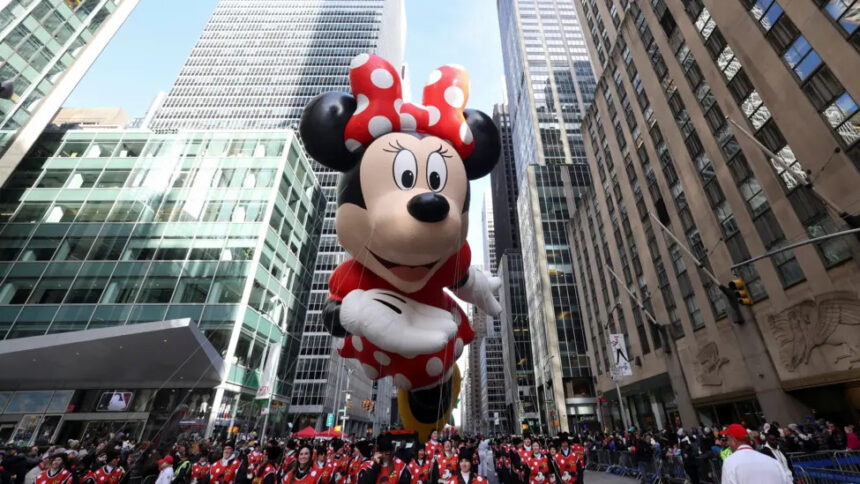
For the first time since World War Two, the Thanksgiving parade in New York City might be disrupted by strong winds on Thursday.
The Macy’s Thanksgiving Day Parade, which is scheduled to take place for the 100th time, may be affected by a strong Nor’easter storm, which might make it too windy for the event’s famous balloons to fly.
From 10:00 local time (15:00 GMT) on Thursday to 01:00 (06:00 GMT) on Friday, the US National Weather Service has issued a high wind warning. Although the highest winds are probable, gusts might reach 60 mph (97 km/h).
Quick Facts
| Detail | Information |
|---|---|
| What happened | Strong winds, heavy rain, and storm conditions threaten parade balloons and Thanksgiving travel. |
| Where | Parade route, coastal areas, and other eastern and interior parts of the United States. |
| When | Thursday, with winds peaking in the evening and coastal high tide flooding at night. |
| Who is involved | Parade organizers, balloon handlers, travelers, and coastal and inland communities. |
| Current status | Forecasters warn winds near flight limits during the day, peaking after the parade. |
| Why it matters | High winds risk grounding balloons, while rain, snow, and coastal tides disrupt holiday travel. |
What is the Macy's Thanksgiving Day Parade?
In an effort to increase holiday sales, staff at the Macy’s department store in New York City organized the parade, which was originally known as the Macy’s Christmas Parade.
On Thanksgiving Day in 1924, the inaugural event was held. Its only cancelation occurred during World War II, when it was suspended from 1942 until 1944. Consequently, this year is the 100th parade.
Marching bands, street performers, and floats will parade through the streets of New York City during the event, which is scheduled to begin at 8:30 local time (13:30 GMT) and finish at about 12:00 (17:00 GMT).
Parade Balloon Rules and History
However, full-size balloons are prohibited from flying by city laws if continuous winds reach 23 mph (37 km/h) or if gusts surpass 35 mph (56 km/h).
Thursday might bring winds that are close to those intensities.
The 1997 route was a no-fly zone due to record wind gusts, but the balloons were nonetheless part of the procession.
That year, the enormous character balloons were attached to golf carts.
When a severe blizzard in 1989 prevented balloon handlers from reaching the parade route, the cheer and dance teams intervened to move the enormous balloons.
What is the forecast?
The Gulf of Mexico has had a number of showers and thunderstorms during the past several days.
This region of unstable weather is now heading north, near the east coast, and intensifying into a powerful area of low pressure known as a Nor’easter storm, so named because it brings powerful winds from the northeast that push against the east coast.
It goes into effect halfway during the procession and alerts people to severe to destructive wind gusts that might damage trees and power lines and seriously impede traffic.
Storm Winds, Flooding, Travel Disruption
The biggest gusts are expected to occur after the parade, as the winds are predicted to increase throughout the day and climax in the evening. They run the danger of getting close to the threshold that would cause the balloons to ground, though.
Rainfall of up to 3 inches (75 millimeters) might result in flooding, which could be made worse along the coast when high tides approach on Thursday nite.
Travel difficulties for Thanksgiving will be exacerbated by severe rain and high winds in other eastern sections of the United States, as well as snow in some interior areas.