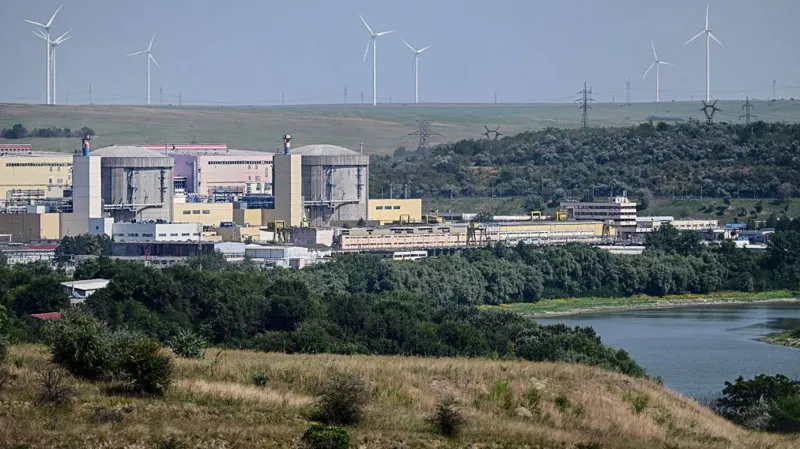
Due to the exceptionally low water levels in the Danube River brought on by the extended hot weather that has affected all of Europe, Romania has closed its sole nuclear power plant.
It is not anticipated that the two reactors at the Cernavodă facility, which generates around 20% of Romania’s power, would be reactivated in the next ten days.
Authorities sank barges full of rocks in the Danube earlier this week in an attempt to enhance the water flow to the plant, which utilizes it for cooling.
Romania Shuts Down Cernavoda Nuclear Plant as Danube Falls
Hungary, a neighbor that also utilizes the Danube, has managed to avoid shutting down its sole nuclear facility in Pakistan as far. of various nations, the waters of the second-longest river in Europe have dropped to their lowest levels in thirty years.
Just before noon on Thursday, the second of Cernavodă’s two 706 megawatt reactors was cut off from Romania’s electrical grid.Romeo Urjan, the director of the factory, told the AFP news agency, “We do not anticipate a restart within the next ten days.”
In July, the first reactor had already been shut down.
Cernavodă has only been closed once previously, in 2003.
Romania Shuts Down Cernavoda Nuclear Plant
During hot, windy days, solar and wind power often make up the power gap; but, in the nights, imports will need to be added to conventional coal and gas-powered generating.
The same low river levels that prompted the nuclear shutdown have also severely reduced Romania’s enormous hydroelectric potential.
Last month, Prime Minister Páv Magyar of Hungary issued a warning that the four nuclear reactors at the Soviet-era Paks could have to shut down completely for the first time.
The Danube’s levels were so low, according to plant managers, that the suction nozzles used to draw in water were unable to reach it.
Climate Change Threatens Europe's Economy as Extreme Heat Intensifies
Temperatures are rising globally, but especially in Europe due to climate change.
This is leading to more severe wildfires, more summer heatwaves, and more strain on the seas of Europe.
Another important canal in Europe, the Rhine, is also experiencing low water levels, which is significantly restricting transportation.
The agriculture industry has also suffered significantly across the continent.
According to Coldiretti, the biggest agricultural trade group in Italy, climate-related damage from hail, drought, and wildfires might surpass €3 billion (£2.6 billion; $3.5 billion).
Monique Barbut, France’s Environment Minister, issued a warning after data from the nation’s statistics office indicated that direct and indirect expenses might reach €10 billion to €15 billion.
Wildfires and Extreme Heat Hit Europe
Due to a blazing wildfire, more than 200 persons, primarily tourists, were evacuated from the well-known resorts of Siviri and Fourka in the northern Halkidiki peninsula on Friday.
As temperatures are predicted to surpass 40C (104F) in certain areas on Friday, up to 80 departments around France are currently under a heatwave alert.
Fires have already devastated the nation in recent weeks, and this year they have caused more damage than at any other point since World War Two.
Temperatures as high as 37C were recorded on Thursday in central Spain, which is also still recuperating from recent devastating wildfires.
According to the Met Office, London recorded a preliminary temperature of 38.1C on Thursday, making it the warmest day of the year in the UK.
The Met Office reported a preliminary reading of 38.1C at London’s Kew Gardens on Thursday, making it the warmest day of the year for the UK thus far.
In the West Midlands, many flames were raging, resulting in the destruction of four homes and multiple reported injuries.
Although more areas of the UK are predicted to get rain over the weekend, the BBC climate and science team believes that more than just showers will be needed to solve the country’s severe drought.