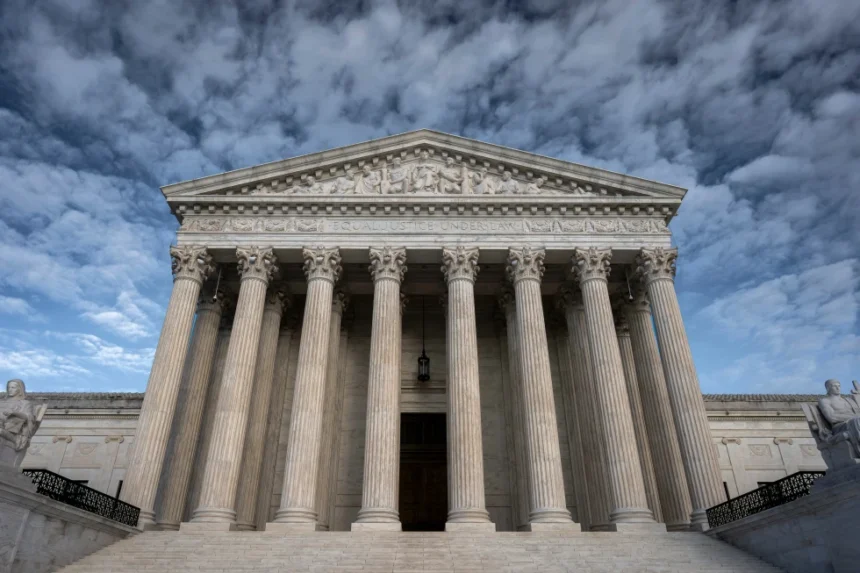
The United States Supreme Court opens its new term on Monday with several big issues that could impact climate policy, immigration, voting rights, and religious freedom.
The justices will hear cases involving the Trump administration, state governments, energy firms, and religious organizations. Several rulings have the potential to have far-reaching consequences for those engaged in the cases.
Quick Fact
| Issue | What the Court Will Consider |
|---|---|
| Climate change | Whether energy companies can face lawsuits over climate related damage. |
| Immigration | Deportations to third countries and mandatory detention policies. |
| Voting | Arizona rules involving proof of citizenship and voter registration records. |
| Religious rights | Whether religious preschools can join publicly funded programs while following state nondiscrimination rules. |
Climate change
The Supreme Court is beginning its session with a big climate change issue. The justices will hear an appeal by energy corporations seeking to halt dozens of lawsuits aiming to make them accountable in court for climate change-related damages.
Billions of dollars might be at risk in a lawsuit out of Boulder, Colorado, where municipal authorities claim the sector should pay cover the rising costs of climate-related calamities.
Suncor and ExxonMobil argue that litigation are not the appropriate method to address the worldwide issue. They have the support of the Trump administration.
Assault weapons bans
Challengers argue that these prohibitions violate the Second Amendment. They claim that AR-15s and comparable rifles are among the most popular and widely held firearms in the country.
The conservative-majority court has strengthened gun rights in recent years, and four justices have indicated that it was only a matter of time before the court addressed the issue. The matter will be considered in December.
The court will hear two key immigration issues that might have far-reaching repercussions for Trump’s crackdown.
One concerns deportations of migrants who cannot be immediately returned to their native nations. The Trump administration has been transferring thousands of people to nations with whom they have no links through a series of often-secret arrangements.
The Supreme Court will consider reversing lower court rulings and giving them a chance to object. The judges have permitted the flights to operate in the interim.
The other complaint concerns the administration’s mandatory detention program for undocumented immigrants.
Voting
This term, the justices will also hear arguments from Republicans seeking to uphold draconian Arizona voting rules.
One provision asks people to produce proof of citizenship when registering to vote on a state form, while another calls for frequent purges of the voter lists to eliminate persons whose citizenship cannot be established.
It comes as Trump has failed to pass legislation demanding documented evidence of citizenship when registering to vote in Congress. Arguments are scheduled for December.
Why This Supreme Court Term Matters
The cases before the justices address a number of key national concerns. Climate responsibilities, immigration enforcement, voting regulations, and religious freedom may all undergo significant changes.
Because Supreme Court decisions have the potential to set national legal norms, they may have an impact on governments, corporations, schools, and millions of individuals across the country.