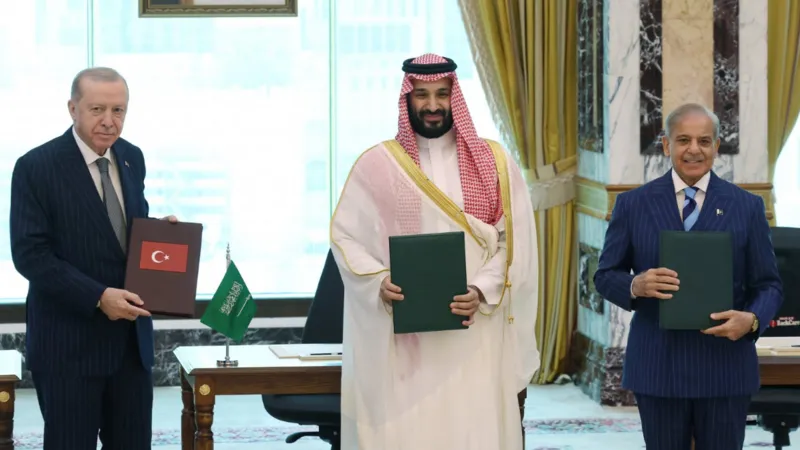
Saudi Arabia, Turkey, and Pakistan signed a cooperative defense agreement that states that an attack on any one of them would be deemed an attack on all three.
The agreement was revealed during a visit in the Saudi city of Mecca between Pakistani Prime Minister Shehbaz Sharif, Turkish President Recep Tayyip Erdogan, and Saudi Crown Prince Mohammed bin Salman.
Tehran and its allies targeted targets in Saudi Arabia and other Gulf states following the US and Israel’s attack on Iran on February 28. They also interfered with commerce across the Red Sea and the Strait of Hormuz, a vital oil shipping route.
Saudi Arabia, Turkey and Pakistan Defence Pact
Tehran has reacted sharply to the Mecca accord, with a top parliamentarian stating that Saudi Arabia will not benefit from it.
Ebrahim Rezaei, a member of the National Security Commission, wrote on his X, “The Saudis should understand that a paper agreement with Turkey and Pakistan does not bring them security.
A comprehensive defense agreement between Saudi Arabia and Pakistan was previously revealed last year.
Three of the most powerful Muslim countries in the world have joined together to give mutual defense guaranties under the new Mecca Joint Defense Agreement.
Why Is the Defense Agreement Important?
It seeks “to strengthen collective deterrence against any act of aggression and stipulates that any armed attack against any one of the three states shall be regarded as an attack against them all” , a joint statement said.
It also calls for improving all facets of the three States’ defense cooperation.”
The agreement promises to help one another, but it doesn’t specify what each side must do.
The agreement was described as “purely defensive in nature” by a Turkish official cited by the Reuters news agency.
Each of the three countries—Pakistan, Saudi Arabia, and Turkey—brings unique assets to the table and has distinct goals.
What Pakistan Gains From the Pact
The agreement provides Pakistan with distinct but complementary advantages. Its long-standing hostilities with India erupted into actual warfare in May 2025.
Even tho a full-scale conflict was prevented, having Saudi Arabia’s economic might and Turkey’s military and industrial prowess on their side will be seen as increasingly beneficial.
Additionally, it coincides with Pakistan’s increasingly important position in international diplomacy.
It has greatly improved its standing in the area by serving as a go-between for Iran and the US and hosting ceasefire talks, which this agreement further solidifies.
What Turkey Gains From the Agreement
The advantages are different for Turkey. Burcu Ozcelik of the London-based Royal United Services Institute (Rusi) claims that the agreement presents “joint production, technology partnerships, procurement and greater military interoperability” potential for the nation’s major defense companies.
Although the idea of a mutual defense pact appears simple on the surface, the situations in which they would be applicable are really complicated and unpredictable.
For instance, if Saudi Arabia’s full-scale conflict with the Houthis resumed, would Turkey be required to participate in attacks on Yemen?
Iran Reacts to the Agreement
Should the crisis with Pakistan resurface, will Saudi Arabia have to declare war on India?
Every situation would need intricate calculations and cautious diplomacy, frequently in an effort to prevent escalation.
However, deterrence is the one outcome of a mutual defense pact that all parties will be depending on.
Aggression may still be conceivable because each of them now has two more regional powers on their side, but the potential cost will be much higher.