
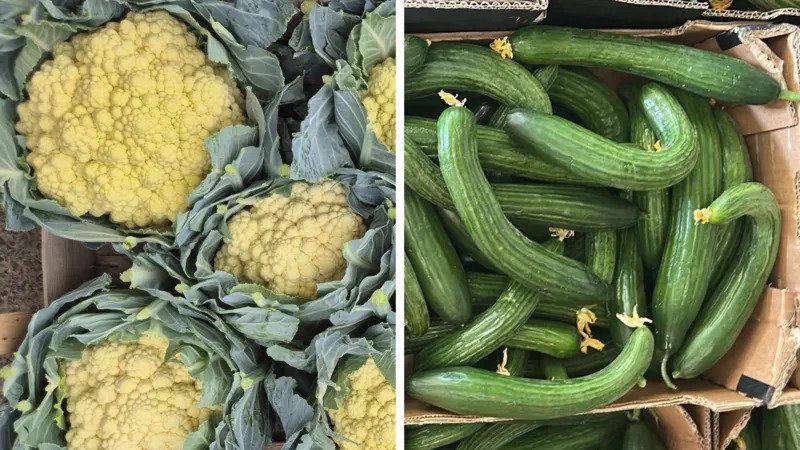
Would you purchase a cucumber that has curled back on itself or a cauliflower that appears to have been sunburned?
One of the warmest and driest growing seasons in decades is a challenge for farmers throughout the United Kingdom.
The worst harvest since records have been predicted as a result of repeated heatwaves following a warmer-than-normal spring.
The amount and appearance of vegetables are both being impacted by the heat.
UK Heatwave Changes the Appearance of Vegetables
Fruit and vegetables that don’t adhere to tight size, shape, and color requirements are typically rejected by retailers. However, companies are now likely to relax such regulations in order to avoid bare shelves due to supply constraints.
In the upcoming weeks, consumers may see smaller, wonkier, or strangely colored vegetables on the market, but producers and vendors claim they are still edible.
The intense heat this year is causing cauliflower heads to turn yellow instead of white.
Because cauliflower requires a lot of water, it is one of the vegetables most impacted by hot weather.
Heatwave Turns Cauliflowers Yellow
Normally, the leaves protect its heads from the sun, but this year, more light is reaching them, causing them to become yellow.
It is “purely a cosmetic defect” and the plants taste precisely the same, according to Emilie Vanpoperinghe, co-founder of Oddbox, a subscription service that offers excess vegetables that retailers reject.
According to her, 6,000 cauliflower heads that were too dark for stores to sell were purchased by Oddbox last week.
According to Vanpoperinghe, growers are reporting that their water sources are running low. As a result, the cauliflower and broccoli family of brassicas will grow more slowly, resulting in shorter supply.
Because “their biggest nightmare is empty shelves,” stores may soon begin offering “sun-tanned” cauliflower due to the shortage, she claimed.
Heatwave Leaves Cucumbers Curled and Pak Choi Damaged
Cucumbers are also curling back in on themselves due to the extreme heat.
Additionally, growers are reporting that some of their cucumbers are twisting back into a spiral.
According to Vanpoperinghe, “even if they get the irrigation then it’s just extreme heat, which means the plant is not able to grow anymore.” This is because the plants are cultivated in greenhouses that overheat in the high outside temperatures, stressing the plants.
Harper A close-up of a hole-filled pak choi. The leaves of John Harper’s pak choi are being eaten by pests that thrive in the heat.
Worcestershire farmer John Harper cultivates pak choi for Sainsbury’s, Aldi, and Co-op.
There are already special sections for wonky veggies at supermarkets including Morrisons, Waitrose, Tesco, and Sainsbury’s.
Waitrose’s produce technical manager, Calum Kelly, stated that “we relax size and shape guidelines for key veg to avoid waste and provide more income to our growers and farmers” during severe weather.
If the drought persists this crop, baking potatoes may be slightly smaller than usual. Like many of us during a heatwave, all of these vegetables still taste fantastic, but they may not look their best.
However, not all gaps can be filled in this manner. Supermarkets are also importing more food from overseas because UK stocks are running low, according to Andrew Opie, director of food and sustainability at the British Retail Consortium.
UK Farmers Face a Future of Hotter and Drier Summers
This implies that a season like this one could become less of an anomaly and more of a sneak peek into the problems that British agricultural faces on a daily basis.
Many farmers will either need to find a method to sell more faulty food to customers, invest in better irrigation and water storage systems, or tolerate more trash.
This year, more people should consider purchasing defective vegetables if they encounter them in the grocery store aisle, according to Munns, the potato farmer.
She advised people to “be a bit less picky” about fresh fruit. “We’ve been overindulged in the UK. We wouldn’t have an option in other less fortunate nations.