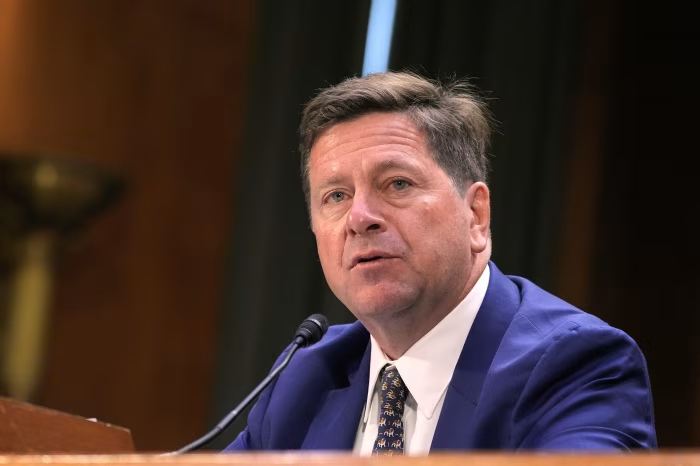
In order to maintain American leadership in the global AI race and safeguard the interests of the American people, the White House established the Super Intelligence Force, a new artificial intelligence (AI) task force, over the weekend.
The rationale is straightforward: while avoiding overregulation and regulatory capture that would stifle innovation and competition, the United States should take the lead in detecting new AI security concerns and safety dangers, particularly those presented by enemies.
Success, however, depends on the U.S. government managing a variety of conflicts and conflicting interests to maintain public confidence, guaranty safety, and for AI businesses to flourish.
Quick Fact
| Detail | Information |
|---|---|
| What Happened | Proposal for shared US AI safety standards |
| Location | United States |
| When | AI policy discussions in 2026 |
| Key Participants | US policymakers, AI companies, researchers, and industry groups |
| Current Status | Proposed approach, final approval not confirmed |
| Main Goal | Improve AI safety, security, and public trust |
| Economic Impact | Potential growth in AI testing, certification, and security services |
| Global Significance | Strengthen US competitiveness in the global AI market |
Trump Shifts AI Safety Leadership to Industry
An key concession made by Trump that many have yet to notice is that AI businesses are urged to “meet regularly to establish standards and best practices to improve the safety of their systems.
” That was a change in tone from only a few weeks prior, when Trump said, “We’re going to watch it closely through the Department of Justice,” implying that he would control the AI industry.
The new AI task group now claims to aggressively monitor opponents’ abuse of the technology while also adhering to Trump’s directives to allow the sector take the lead in safety and risk management.
In actuality, Director of National Intelligence Jay Clayton, Trump’s new AI czar, would probably implicitly approve the six AI firms’ creation of an AI self-regulatory organization (SRO) to coordinate and develop incident-response guidelines and safety standards.
In order to make sure that SRO developments are in line with public interests and national security, the task group will probably offer optional guidelines. It will also evaluate if these initiatives may hurt the United States’ ability to compete with China.
In order to formalize the government’s enforcement and monitoring responsibilities over the AI SRO, it will also determine if further executive or legislative backstops are required.
Who Should Set AI Safety Standards?
The debate’s parameters are determined by whomever establishes the safety criteria. If the six AI firms are allowed to choose what constitutes safety, how to quantify it, and who evaluates their own safety standards, no one will believe them.
For their part, the civil society and national security groups would probably concentrate on whether these tools may leak sensitive personal data or provide classified insights, respectively.
Building Public Trust in AI Safety Regulation
The public and U.S. allies must believe that whatever is constructed is genuine.
The Financial Industry Regulatory Authority’s hundreds of members and independent board of public-interest directors have won it respect by preventing a few financial corporations from potentially capturing it.
The AI SRO should include frontier AI deployers in the financial and healthcare sectors, important government and national security AI laboratories, and technology public-interest organizations in addition to its first six core AI business members.
These organizations ought to offer guidance on establishing security and safety requirements.
AI Incident Response Protocols for Trust
Create AI incident-response procedures that foster responsibility and confidence.
The SRO and the AI task force can work together to develop notification protocols for significant cybersecurity or national security AI issues, like the recent OpenAI incidents that compromised Hugging Face, a tech business, and other institutions throughout the globe.
The reaction will be restricted and trust in the industry’s self-regulation will decline in the absence of a uniform process for AI firms and the national security community to comprehend and address continuing issues. As part of the U.S.-China Dialog, comparable notification criteria and protocols might be modified and shared with Beijing to lessen confusion.
Strengthening Safety Standards for Open-Source AI Models
Encourage open-weight models to adhere to accepted AI safety norms.
The open-weight model market, which provides little to no assurance of security safety and is covertly utilized by U.S. corporations, would be a lost opportunity if the AI task force and SRO sought to strengthen safety for closed, proprietary models.
As strong proponents of open and secure AI, Nvidia and Meta need to fund the OASIS Coalition for Secure AI and the Linux Foundation’s Open Secure AI Alliance in order to create a team that prioritizes widely used open-weight models, regardless of provenance, to retrain, improve, and secure build protections.
AI Safety Standards to Outcompete China
Gain an edge over China by developing a new, long-lasting safety sector. Open-source software from overseas, such as Finland’s Linux operating system kernel and France’s FFmpeg video processing package that powers web streaming, has frequently been used by American businesses to create organizational value. Additionally, the sector can control AI capability testing, assessment, certification, and support services.
The U.S. government, regulated sectors, and suppliers of vital infrastructure should utilize their procurement authority to mandate that AI services adhere to the safety and security requirements of the SROs.
If the SRO is successful, the US may engage with allies and international organizations to gain momentum in standard-setting.
Balancing AI Innovation with Safety Standards
NASCAR did not request a suspension of racing following the 2001 collision that killed racing great Dale Earnhardt Sr. Rather, it concentrated on controlling energy impact and safeguarding the driver within the vehicle.
The US may set norms that competitors must adhere to if it creates a reliable SRO to regulate security and safety procedures for both closed and open AI models.
China’s win-win arguments, in which China wins twice, are usually ridiculed by Washington insiders. In terms of advanced capabilities and safety, the United States can now triumph twice as well.