Balen Shah, the prime minister of Nepal, has frequently demanded that his nation be treated equally by its strong neighbors. That strategy was put to the test on his first visit to Delhi, the capital of India, as both parties attempted to mend a relationship damaged by years of conflict.
The two leaders were very different from one another.
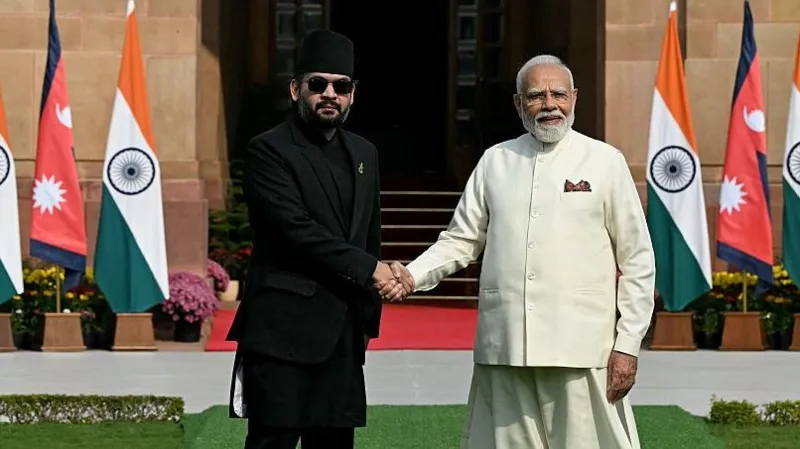
Shah, 36, appeared beside to Prime Minister Narendra Modi, 76, who was dressed in white, sporting his signature black suit and sunglasses. After his predecessor was overthrown by a wave of Gen Z-led demonstrations, Shah came to power.
Quick Facts
| Category | Details |
|---|---|
| Main Development | India and Nepal strengthen diplomatic relations |
| Location | New Delhi, India |
| Key Leaders | Narendra Modi and Balendra Shah |
| Financial Support | $1.62 billion announced by India |
| Key Agreements | Trade, energy, transport and education |
| Additional Ports | Kandla and Paradip |
| Main Challenge | Border disputes and balancing relations with India and China |
| Expected Impact | Economic development and flood reconstruction |
India and Nepal Strengthen Bilateral Ties
In the meantime, Modi, who is currently in office for a third term, has recently been the target of student-led demonstrations in India.
However, the two leaders appeared committed to projecting a more cordial relationship. Together, they inaugurated a new cross-border train service, reviewed a military guard of honor, and exchanged presents.
There was much more at risk for Nepal than just mending diplomatic relations.
A number of agreements pertaining to commerce, hydropower, transportation, and youth education in Nepal were announced by the two nations.
More importantly, as Nepal recovers from the disastrous floods earlier this year, India announced a $1.6 billion (£1.22 billion) aid package.
India Pledges $1.6bn for Nepal's Recovery
Over 1,400 people were killed by the floods, and many are still unaccounted for. Shah’s administration has come under fire for helping families who have lost loved ones and properties.
Reconstruction is a major problem for the nation. Rebuilding might cost up to $4.8 billion, according to official estimates. Shah cautioned that “the answer cannot simply be another mega-loan” when poorer nations are devastated by climatic disasters in a September speech to the UN General Assembly.
Modi promised Indian funding of about $1.6 billion. Along with around $400 million in grants for infrastructure and rehabilitation, the most of it will be provided as a line of credit for energy projects.
Nepal Balances Ties Between India and China
Nepal, a country with a majority of Hindus, has long had to manage conflicting interests from its two powerful neighbors, China and India. Ties with India have always been hampered by claims of political meddling and an unsolved border conflict.
Many people believed that KP Sharma Oli, the former prime minister of Nepal and leader of a communist party, was closer to China. In contrast, Shah’s election earlier this year made him a political outsider.
The border conflict was seldom mentioned in the leaders’ public statements, which might be explained by his new strategy for dealing with India.
Nepal Secures Trade and Transport Gains
“Right now you can go home and convince the young Nepalis that it will be handled later,” Pokhrel states, “but if they don’t deal with these issues in the future, there will be criticism.”
Anil Trigunayat, a seasoned Indian diplomat, claims that rather than engaging in what he refers to as “cartographic aggressions,” both parties seem to have chosen to leave the conflict to existing processes.
The visit to Delhi has additional benefits for Nepal.
Nepal gained access to two more Indian ports, Kandla and Paradip, because it is a landlocked nation that is mostly dependent on India for commerce.