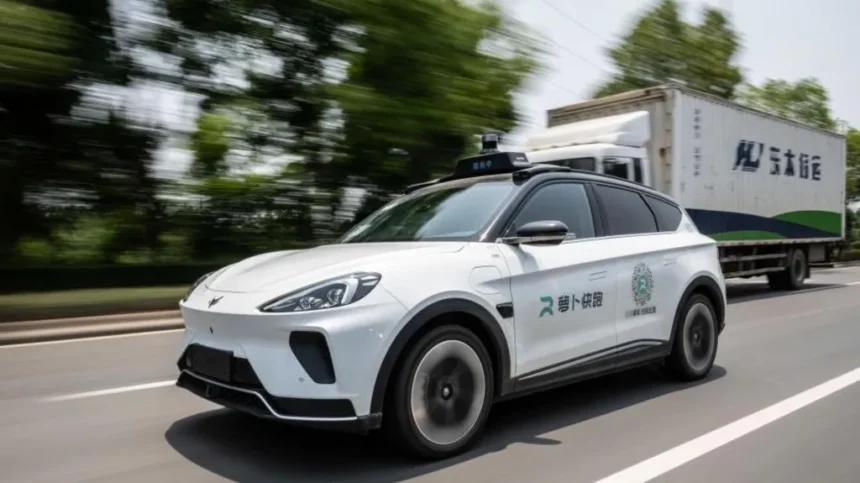
Uber and Lyft have announced plans to trial Chinese-built robotaxis in the United Kingdom in 2026. The companies are collaborating with the Chinese technology firm Baidu to introduce its Apollo Go driverless taxi service to London, pending regulatory approval.
The move signals growing interest in autonomous transport as the UK prepares new rules for self-driving vehicles.
Baidu’s Apollo Go Track Record
Baidu’s Apollo Go service already operates in dozens of cities, mainly in China. It has completed millions of rides without a human driver. Uber and Lyft believe this operating history could help address safety concerns as the technology expands abroad.
Both companies say the partnership could introduce a new transport option for urban यात्रers if trials are approved.
Government Support for Self-Driving Vehicles
UK transport secretary Heidi Alexander welcomed the announcement. She described it as another sign of confidence in the government’s plans for autonomous transport.
In a post on X, she said passenger-carrying self-driving vehicles could begin operating from spring under a new pilot scheme. The government says safety and careful testing will remain the top priority.
Uber Accelerates UK Autonomous Plans
Uber confirmed earlier this year that it would bring forward its UK driverless car trials. This follows government efforts to speed up a legal framework for small commercial autonomous services, including taxi-style vehicles, by 2026.
Uber said its partnership with Baidu would help position Britain as a leader in future transport. The company also said London riders could benefit from an additional reliable travel option.
Lyft Targets Expansion in Europe
Lyft has also outlined plans to deploy Baidu-powered robotaxis in the UK and Germany. The company already offers autonomous rides in Atlanta in the United States.
Uber also operates robotaxis in the US through its partnership with Waymo. Both firms see Europe as the next major testing ground.
Lyft chief executive David Risher said London passengers would be the first in the region to experience Apollo Go vehicles. If approved, Lyft plans to begin with dozens of cars. The fleet could later grow to hundreds.
Regulatory and Scaling Challenges
Despite the optimism, regulatory approval remains a major hurdle. Experts warn that autonomous vehicles cannot scale as quickly as digital services.
Jack Stilgoe, professor of science and technology policy at University College London, said small trials are very different from a full transport system. He noted that public roads are not laboratories and scaling must be handled carefully.
Public Trust and Safety Concerns
Public confidence remains limited. A YouGov poll from October found that nearly sixty percent of UK respondents would not feel comfortable riding in a driverless taxi.
Around eighty-five percent said they would still choose a human-driven cab if price and convenience were equal. Safety, privacy, and reliability were key concerns.
Reports of autonomous vehicles causing traffic problems continue to surface. Waymo recently paused its San Francisco service after vehicles stopped operating during a power outage.
Congestion and Urban Impact
Professor Stilgoe also warned about congestion risks. London has worked hard to reduce traffic in its city centre.
He said empty driverless vehicles could worsen congestion rather than reduce it. According to him, the only thing worse than a single-occupant car is a car with no passengers at all.