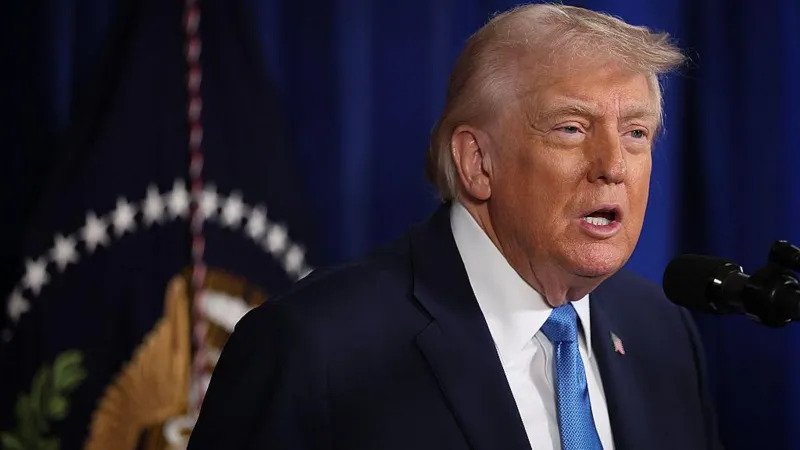
Former US President Donald Trump has said Venezuela will hand over between 30 and 50 million barrels of oil to the United States after a US led military operation removed President Nicolás Maduro from power.
Trump said the oil, worth about 2.8 billion dollars, would be sold at market rates. He added that he would personally control how the money is used, saying it would benefit both the Venezuelan people and the United States.
The statement was shared on his Truth Social account shortly after Delcy Rodríguez was sworn in as Venezuela’s interim president. Maduro has since been taken to the US, where he is expected to face charges linked to drug trafficking and weapons offenses.
Trump Sees Oil as a Strategic Win for the US
Trump said Venezuela becoming an active oil producer again would help the US by keeping global oil prices lower. He also claimed that American oil companies could repair and restart Venezuela’s damaged oil industry within 18 months.
He added that large investments from US companies were likely once operations begin.
Energy experts, however, have pushed back on that idea. Analysts previously told the BBC that restoring Venezuela’s oil output could take many years and cost tens of billions of dollars. Even with investment, results would not be immediate.
Concerns Over Global Impact and Stability
Experts also doubt the plan would have a major effect on global oil supply or prices. Many companies would want proof of long term political stability before committing money. Oil projects of this scale often take years before producing results.
Venezuela holds an estimated 303 billion barrels of oil, the largest proven reserve in the world. Despite this, production has been falling since the early 2000s due to underinvestment, mismanagement, and sanctions.
Venezuelan oil is heavy and costly to refine, which adds another challenge. At present, Chevron is the only major US oil company still operating in the country.
US Oil Companies Respond Cautiously
Chevron said it remains focused on employee safety and follows all laws and regulations. The company did not comment on future expansion plans.
ConocoPhillips, which no longer operates in Venezuela, said it is watching developments closely but that it is too early to discuss any new investments. Exxon did not respond to requests for comment.
Reports also suggest that Trump asked Venezuela’s interim leadership to give the US exclusive access to its oil industry and cut economic ties with China, Russia, Iran, and Cuba.
China Condemns US Actions
China, currently Venezuela’s largest oil buyer, strongly criticized Trump’s announcement.
A spokesperson for China’s foreign ministry said the US actions violate international law and Venezuela’s sovereignty. China also warned that its legal rights and interests in Venezuela must be respected, stressing that cooperation between China and Venezuela is protected under international law.
Dispute Over Claims of Stolen Oil
Trump and Vice President JD Vance have claimed Venezuela seized or stole American owned oil in the past. Vance said Venezuelan authorities used expropriated assets to fund criminal activity.
Experts say the situation is more complicated.
US oil companies operated in Venezuela under licensing agreements for decades. Venezuela nationalized its oil industry in 1976 and increased state control in 2007 under President Hugo Chávez.
That move led to legal disputes. In 2019, a World Bank tribunal ordered Venezuela to pay 8.7 billion dollars to ConocoPhillips as compensation. That payment has not been made.
However, analysts note that under international law, natural resources belong to the sovereign nation. The oil itself was never legally owned by foreign companies, only extracted under agreed terms.