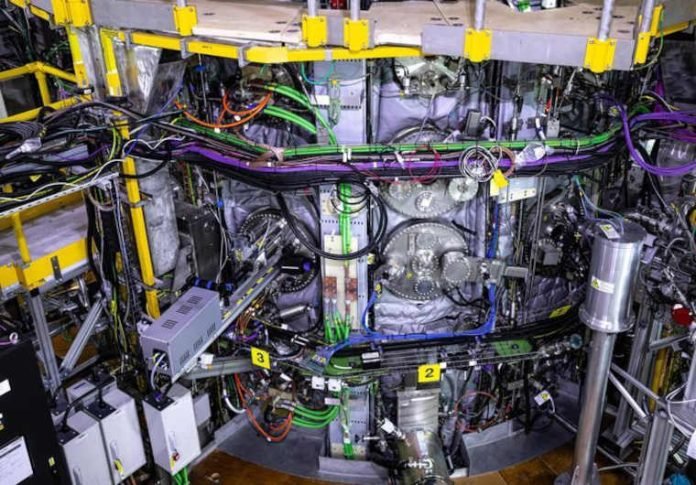
MAST Upgrade Begins New Fusion Research Phase
The UK Atomic Energy Authority has launched a new phase of fusion research. Its flagship machine, MAST Upgrade, has started its fifth scientific campaign.
The six-month programme moves the UK closer to building its first fusion power plant. At the same time, it strengthens Britain’s role in global fusion research.
More than 200 scientists from over 40 international institutions will take part. Together, they plan to run around 950 controlled plasma pulses.
Each pulse traps superheated plasma inside the machine for a short time. These tests provide critical data on plasma behaviour under extreme conditions.
Global Interest Drives Collaboration
According to James Harrison, Head of MAST Upgrade Science, this campaign builds on major successes from the last phase.
He noted strong international interest in the facility. As a result, MAST Upgrade has become a key hub for global fusion collaboration. Over the coming months, the team aims to push spherical tokamak research even further.
Why Fusion Energy Matters
Fusion is the same process that powers the Sun. It releases energy when light atoms combine to form heavier ones.
Unlike fossil fuels, fusion produces no carbon emissions during operation. It also creates very little long-lived radioactive waste. In addition, it relies on widely available fuels such as hydrogen isotopes.
Because of these advantages, fusion could deliver a steady and clean energy supply. If successful, it would support renewables and help meet net-zero goals.
Goals of the Latest MAST Upgrade Campaign
This campaign focuses on improving spherical tokamak performance. It also feeds directly into the design of future power plants, including the UK’s STEP Fusion programme.
Spherical tokamaks are smaller than traditional designs. Therefore, they could lead to more compact and affordable fusion reactors.
By running a large number of plasma pulses, researchers can test many conditions. This approach speeds up learning and strengthens predictive models.
Key Research Areas
The campaign targets four major research priorities.
First, scientists will study high-pressure plasmas. These experiments help refine predictions for reactor-level performance.
Second, the team will improve plasma control. For the first time, they will combine instability control with advanced exhaust systems such as the Super X divertor.
Third, researchers will optimise divertor design. Better heat handling could lower reactor size and cost, improving commercial viability.
Finally, scientists will test advanced computer models against real data. These tools support future machines like STEP and ITER.
Building on Recent Breakthroughs
The fifth campaign follows a successful earlier phase. During that campaign, MAST Upgrade achieved several world firsts.
The team suppressed plasma instabilities in a spherical tokamak. They also reached a record 3.8 megawatts of heating power. In addition, they controlled plasma exhaust in both upper and lower divertors.
These results attracted more than 100 research proposals. This response highlights the facility’s global importance.
Major Upgrades Ahead
Further upgrades will expand MAST Upgrade’s capabilities.
In 2026, researchers will install an Electron Bernstein Wave heating system. This system matches the technology planned for STEP Fusion.
Between 2026 and 2027, new neutral beam injectors will double heating power. MAST Upgrade will then become the first spherical tokamak to use both heating methods at the same time.
Moving Closer to Fusion Power
As the campaign continues, the findings will shape future reactor designs in the UK and beyond.
By combining global expertise, advanced technology, and ambitious experiments, MAST Upgrade plays a key role in turning fusion energy into a real source of clean power.