First session set in Washington
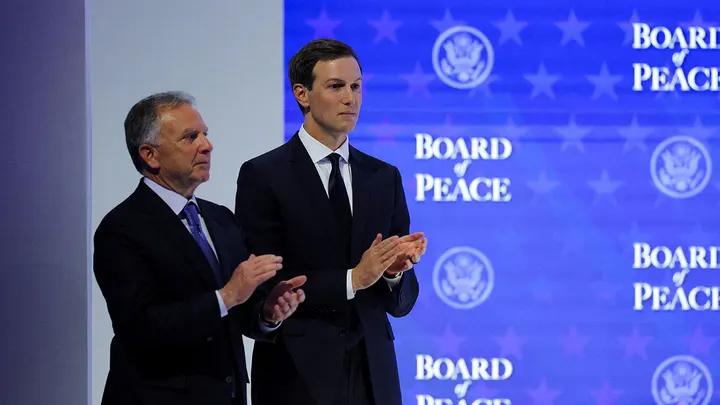
President Donald Trump will chair the first meeting of his newly formed Board of Peace on Thursday in Washington. Administration officials say the gathering aims to move the Gaza ceasefire into its next phase, focusing on reconstruction and long term stability rather than delivering an immediate breakthrough.
More than 40 nations are expected to attend. According to the White House, discussions will center on a multibillion dollar rebuilding plan, humanitarian aid coordination and the possible deployment of an international stabilization force.
White House spokesperson Anna Kelly said the initiative builds on last year’s ceasefire between Israel and Hamas. She added that the administration believes the board could become a major force in shaping peace efforts in the Middle East.
Global participation and early pledges
Trump first introduced the Board of Peace during the World Economic Forum in Davos. Initial members include countries from the Middle East, Europe, Asia and Latin America. Among them are the United Arab Emirates, Saudi Arabia, Egypt, Qatar, Turkey and Israel.
On Sunday, Trump said participating countries had already pledged 5 billion dollars toward Gaza’s recovery. Some nations also signaled willingness to contribute personnel for stabilization efforts. Italy announced plans to help train a future Gaza police force, while Indonesia committed troops for a potential mission later this year.
The UAE, a founding member, said it will continue humanitarian work in Gaza and support efforts aimed at long term peace.
Disarmament remains the key issue
Despite the financial pledges, analysts argue the meeting’s true test will be whether countries agree that Hamas must disarm.
Ghaith al Omari of the Washington Institute said the board’s credibility depends on a clear and unified position on disarmament. Without it, he warned, reconstruction efforts could stall.
John Hannah of the Jewish Institute for National Security of America also questioned how quickly pledged funds would turn into real rebuilding. He noted that many governments may hesitate to invest heavily unless Hamas agrees to demilitarize.
Both analysts stressed that funding alone will not solve Gaza’s deeper political and security challenges.
Netanyahu joins despite tensions
Israeli Prime Minister Benjamin Netanyahu formally joined the initiative after meeting with Secretary of State Marco Rubio. His decision came despite concerns inside Israel about Turkey and Qatar playing prominent roles in Gaza’s future.
Analysts say Netanyahu likely weighed those concerns against the importance of maintaining strong ties with Washington. In their view, strategic cooperation with the United States outweighed short term political friction.
European hesitation and UN questions
Several European governments have declined to join the board. Officials raised concerns that the initiative’s structure may not align with earlier United Nations resolutions.
European Union foreign policy chief Kaja Kallas said the board’s mandate appears broader than the original Gaza specific framework endorsed by the UN Security Council.
Still, U.S. Ambassador to the United Nations Mike Waltz defended the initiative, arguing that the status quo in Gaza cannot continue.
Analysts say the Board of Peace is unlikely to replace the UN system. Instead, they see it as an added diplomatic channel designed to push reconstruction and security talks forward step by step.