
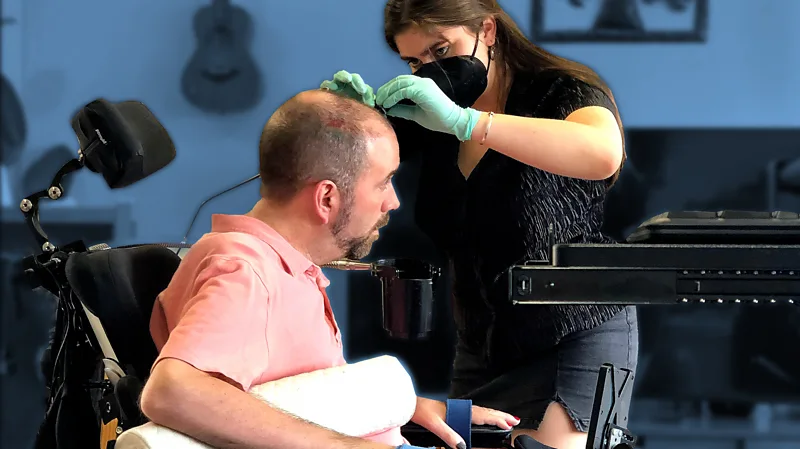
Artificial intelligence is opening a new chapter in neuroscience. For decades, the human brain seemed too complex to decode. Now, researchers are translating brain activity into real time words and images.
A 52 year old woman, known as participant T16, took part in a groundbreaking study at Stanford University. She lost her ability to speak clearly after a stroke nearly two decades ago. Scientists implanted a tiny array of electrodes into the front part of her brain. When she imagined speaking, the device captured the electrical signals from her neurons.
An AI system then converted those signals into text on a screen. She did not move her lips. She did not make a sound. Yet her internal thoughts appeared as full sentences.
This marked one of the closest steps toward what many call mind reading technology.
Turning Brain Signals Into Words
Brain computer interfaces, often called BCIs, connect the brain directly to a computer. These systems record neural activity and use machine learning to detect patterns.
Instead of guessing random thoughts, the AI studies repeated attempts. When a person imagines saying a word, certain neurons fire in a predictable way. Over time, the model learns which pattern matches which word.
In earlier trials, researchers enabled a paralyzed man to write by imagining letters drawn in the air. That method reached 18 words per minute. More recent systems decode attempted speech directly. Some have achieved over 30 words per minute with accuracy close to natural conversation levels.
Natural speech averages around 150 words per minute. Scientists are steadily closing the gap.
From Speech to Visual Mind Captioning
Researchers in Japan recently introduced a system that describes what a person is seeing or imagining. This approach combines non invasive brain scans with multiple AI models.
The system does not access abstract thoughts. Instead, it reconstructs likely images based on known activity patterns in the visual cortex. It works through probability, not magic.
These advances reflect progress in both hardware and software. Brain sensors now capture clearer signals. At the same time, deep learning systems can analyze vast amounts of neural data.
From Lab Research to Commercial Brain Chips
Scientists have explored brain interfaces since the 1960s. Early experiments by neuroscientist Eberhard Fetz showed that animals could control a device using a single neuron.
Today, companies such as Neuralink aim to bring brain implants into clinical use. Their focus remains medical. The goal is to restore communication and movement for people with paralysis or neurodegenerative diseases.
Ethical Questions Around Mind Reading AI
As this technology advances, ethical concerns grow. Neural data is deeply personal. Questions about privacy, consent, and regulation demand clear answers.
Current systems require surgery or controlled brain scans. They also need extensive training for each user. No device can secretly read everyday thoughts. The science works only under strict laboratory conditions.
Still, the impact could be profound. For people who cannot speak, these systems offer a voice. For society, they challenge how we think about privacy and human connection.
Artificial intelligence is not reading minds in the science fiction sense. It is decoding patterns. Yet even that ability may reshape how humans communicate in the future.