
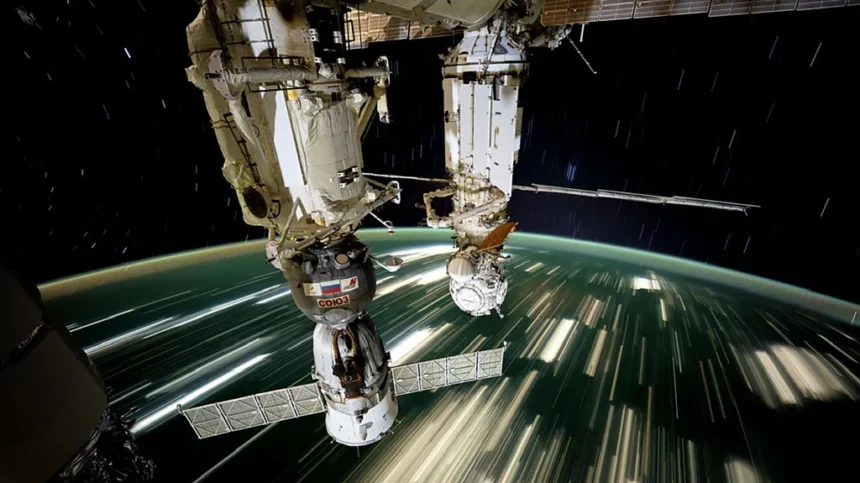
The International Space Station is humanity’s most expensive object in space. It has orbited Earth for 25 years.
Flying about 400km above the planet, the ISS stands as one of the most complex engineering projects ever built. Since the first crew arrived in November 2000, more than 280 astronauts and cosmonauts have visited. Importantly, the station has remained continuously occupied ever since.
If you were born after 2 November 2000, humans have lived in space for your entire life.
Above all, the ISS shows what international cooperation can achieve. That success did not come easily. Delays, budget fights, and political pressure followed the project for years.
Here is the story of the ISS told through 25 key numbers.
27: Age of the oldest ISS module (years)
The first ISS module, Zarya, launched in 1998 from Kazakhstan. At the time, critics questioned whether the project would ever succeed. Costs had ballooned, and delays piled up. Still, Zarya became the foundation of today’s station.
3: Crew members on Expedition 1
When the first crew arrived in 2000, the ISS had only three connected modules. Despite the tight space, the astronauts stayed nearly five months. During that time, they ran experiments, completed spacewalks, and hosted shuttle crews. Today, the ISS usually holds seven astronauts.
42: Assembly flights
Building the ISS required dozens of missions. Space shuttles delivered major components and used robotic arms to lock them into place. Parts came from the US, Russia, Europe, and Japan. Yet they fit together with few serious problems.
388: Habitable volume (cubic metres)
The living space equals a six-bedroom house. However, in microgravity, astronauts use walls and ceilings as freely as floors. As a result, equipment covers nearly every surface.
2: Hours of exercise per day
Life in space weakens muscles and bones. Therefore, astronauts exercise for two hours daily. The ISS gym includes treadmills, bikes, and resistance machines. In 2016, Tim Peake even ran a marathon in orbit.
98: Percentage of water recycled
Almost all water gets reused. Sweat, breath moisture, and urine become clean drinking water. While the system works well, microbes still live onboard. Studies have identified more than 50 types.
4,400: Research papers published
Astronauts spend much of their time on science. Research covers medicine, materials, and technology. Some experiments help treat diseases on Earth. Others support future missions beyond low Earth orbit.
70: Oldest astronaut to live on the ISS
Astronauts no longer need to be young. Don Pettit returned to Earth on his 70th birthday. John Glenn flew again at 77, proving experience still matters in space.
371: Longest single ISS mission (days)
Six-month missions are now routine. NASA astronaut Frank Rubio holds the ISS record after returning in 2023. However, the record belongs to Valeri Polyakov, who spent 437 days aboard Mir.
25: Thickness of Cupola glass (mm)
The Cupola offers the best view of the ISS. Astronauts often lose track of time there. Many have admitted to setting alarms to stop watching Earth drift by.
1: Didgeridoos played
Music thrives in orbit. Astronauts have played flutes, saxophones, and guitars. Don Pettit even turned a vacuum cleaner into a didgeridoo for a science demo.
4: Toilets
Toilets matter in space. When one failed in 2012, Chris Hadfield fixed it himself. He later called it one of his proudest moments in orbit.
40: Manoeuvres to avoid space junk
The ISS regularly dodges debris. With tens of thousands of objects in orbit, the risk keeps rising. Although the station has taken minor hits, it has avoided serious damage.
16: Orbits per day
Travelling at 28,000km per hour, the ISS circles Earth every 90 minutes. Astronauts see 16 sunrises and sunsets each day.
150bn: Total estimated cost (USD)
NASA alone spends up to $4bn each year to operate the ISS. Other partners also contribute. Whether the cost was worth it depends on how you value science, cooperation, and human presence in space.