
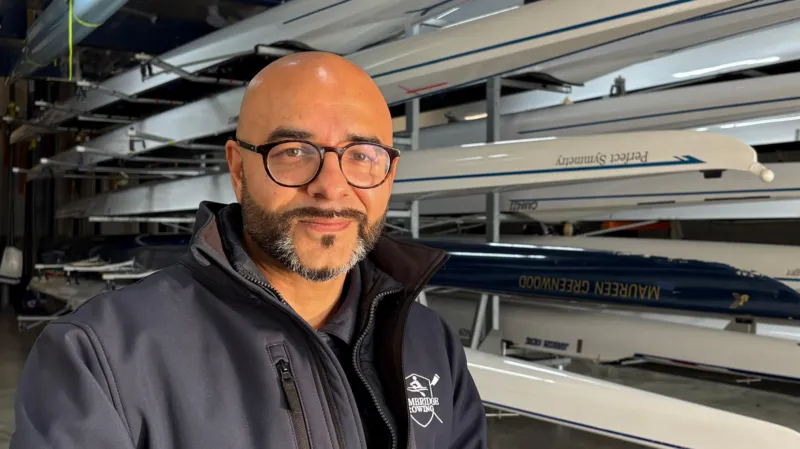
Omar Terywall launched Cambridge Rowing Limited in 2021. The company runs the Cambridge Rowing Experience, giving beginners the chance to row on the River Cam and learn the sport in a real setting.
The name felt obvious to him. The business is based in Cambridge, and rowing is exactly what it offers.
That choice is now at the centre of a trademark dispute with one of the world’s most powerful universities.
Trademark Objection Sparks Legal Challenge
In early 2022, Terywall applied to register his company’s logo as a trademark. The design shows a rower inside a shield with the words Cambridge Rowing underneath.
A few months later, the University of Cambridge formally objected. The university said it must protect its trademarks to prevent misuse and confusion among the public.
A hearing took place in 2025, and a final decision is expected in the coming months.
For Terywall, the experience has been frightening.
He describes the university as a massive institution with vast resources, while his business is small and local.
“When a huge organisation comes after you, it is scary,” he says. “You do not know where to turn.”
A Local Business With Community Impact
Since launching, Cambridge Rowing has introduced more than 5,000 people to rowing. Many of them are local children who had never been on the water before.
Terywall runs the business from the City of Cambridge Rowing Club. This is one of several town clubs in the city that operate independently from the university.
He says he has always had a positive relationship with the colleges and with students. The issue, he explains, is not with individuals but with the institution acting as a legal entity.
While he stops short of direct accusations, he admits the process feels like pressure.
“There is a form of bullying there,” he says. “Even if it is not the intention.”
Why the University Is Objecting
In the United Kingdom, trademarks are registered under specific categories. Cambridge Rowing applied under categories covering sports clothing, merchandise, and sporting events and training.
The University of Cambridge already holds trademarks for the word Cambridge across several categories, including sporting and cultural activities.
The university argues that in areas such as education, research, publishing, and sport, the public associates the word Cambridge with the university itself.
Because of that, it has challenged several businesses that include the word in their names.
“Cambridge Belongs to the City Too”
Terywall says the city of Cambridge existed long before the university was founded in 1209. He also points out that rowing itself predates the institution by thousands of years.
According to World Rowing, early depictions of rowing boats date back to 5800 BC. The sport later developed in England, with the first Oxford versus Cambridge Boat Race held in 1829.
For Terywall, that history matters.
“To claim ownership of the word Cambridge and the word rowing just feels wrong,” he says. “These are shared words. They belong to everyone.”
As he waits for the final ruling, he hopes the case will raise broader questions about how far powerful institutions should go when protecting their brands, especially when small local businesses are involved.