When a wildfire broke out near his First Nation community in northern Ontario, Hubert Wigwas decided to stay put.
He put sprinklers on his roof to extinguish falling embers. He checked on elders in his community who also stayed behind, and he fuelled up four boats down on the lake in case they needed a quick escape.
“This is everything I’ve built in my 58 years,” Wigwas, a councillor from Gull Bay First Nation, told the news. “I’m just not going to run away and let it burn.”
Smoke blocked the air in cities as far away as the Midwest of the United States. President Donald Trump has taken notice and threatened to impose further tariffs on Canada for permitting “filthy, polluted” air to flow south of the border.
A national discussion about whether there are enough firefighters to combat these increasingly difficult fire seasons has been spurred by the escalating wildfires.
When resources are overextended, what happens? And how can isolated communities, which are frequently most vulnerable due to their close proximity to Canada’s extensive boreal forest, learn to cope with this new reality?
Despite facing a punishment of around C$800 ($570; £425) for disobeying evacuation instructions, Wigwas asked himself these questions when he made the decision to remain.
Why Hubert Wigwas stayed in Gull Bay
On July 29, its chief wrote a letter urging individuals who have stayed to leave right once, stating that Ontario firefighters cannot do their duties safely while people are still in their houses.
In British Columbia, where there are presently over 115 fires, officials have been spreading the same message across the nation.
However, Wigwas stated in late July that he had not yet seen firefighters from out of town come to help fireproof buildings or keep an eye on the elderly who were still there due to a wildfire 24 kilometers outside his hamlet.
He claimed that it made him realize how beneficial it would be for his First Nation to establish its own wildfire emergency response and train locals how to save their own houses.
Calls for local wildfire response teams
Although he did not directly answer Wigwas’ assertion, Dave Bradley, a spokesman for Ontario’s ministry of natural resources, stated that the province had been in “constant contact” with First Nations leaders.
Resources for battling fires are allocated according to “fire behavior, weather conditions, and risks to communities,” he continued.
Toronto Star via Getty Images On July 15, a guy swimming in Lake Ontario had a view of the Toronto cityscape, which was covered in a brilliant orange haze from wildfire smoke.
Toronto Star via Getty Images People in British Columbia, a region on Canada’s west coast that has long been at the forefront of the country’s wildfire response, are carrying out Wigwas’s vision for his First Nation.
There are initiatives in place to teach people living in rural and isolated areas how to react to wildfires properly.
Why officials still want people to evacuate
She stated, “There are not enough human beings in Canada with the right training to fight the fires that we have currently, especially over the last five years.”
If there are fires endangering more populous regions, BC firefighting workers may occasionally move remote communities—where the closest town may be hundreds of kilometers away—down the priority list, she added.
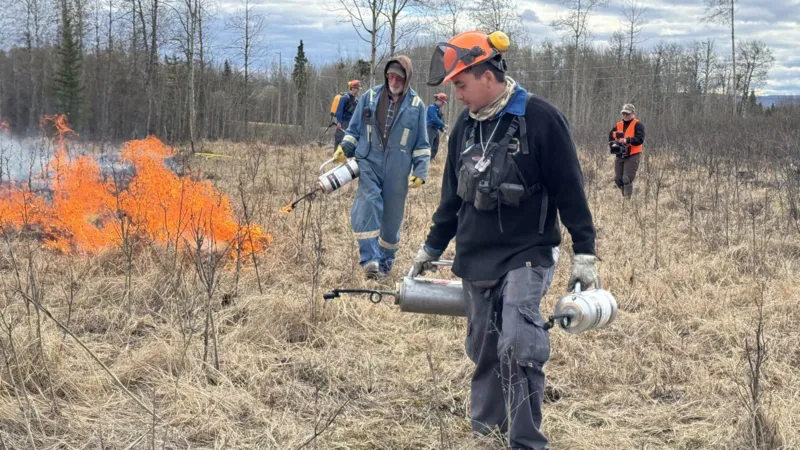
Prescribed burns, sometimes called hazard reduction burns, are a technique used by her team, who are mostly indigenous, to eliminate fuels that might start wildfires.
Can local teams work safely?
Cam Allen, a 70-year-old retired Fort Nelson helicopter pilot who has fought fires from the air, said he just enrolled in a course at Leverkus to learn about ground fire suppression methods and, more generally, how to assist if a fire spreads to his community.
He brought up John Carr, a Californian who gained notoriety last year for remaining behind and using a garden hose to stave off flames during the Palisades fire.
He finally preserved his house even as many around burnt down. It begs the question, “How much more could have been saved if 100 or 1,000 people had stayed behind and truly done what he did?” Allen inquired.
What happens next for Hubert Wigwas?
However, not everyone was as lucky as Carr during the Los Angeles fires, which claimed 29 lives in all. Some of the victims had also disregarded evacuation orders in order to defend their houses, despite authorities’ pleas for thousands of residents to go.
The goals of Leverkus’ group, which the British Columbian government does not formally recognize, underscore simmering tensions between those who enforce evacuation orders and those who disobey them in fire-prone areas.
A man in the Village of Clinton was forced to be rescued by wildfire firefighters in British Columbia last week after he refused to leave his burning home.
The minister in charge of disaster management in British Columbia reaffirmed in a wildfire update on Tuesday.