
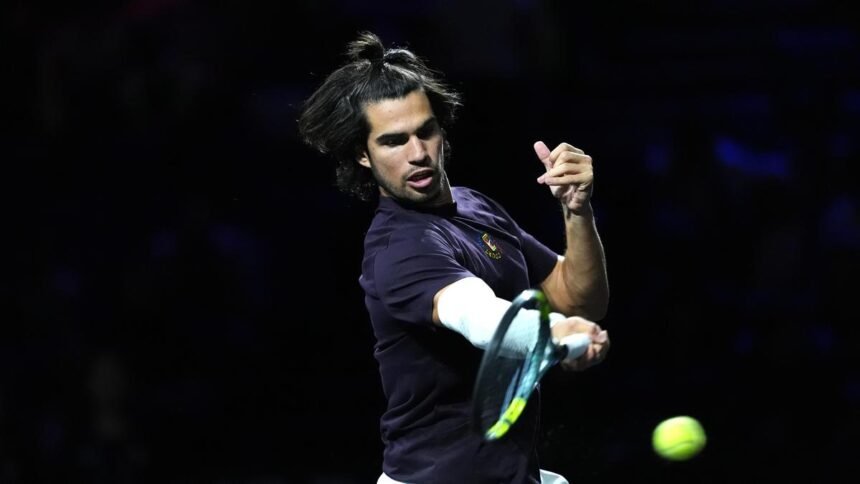
Carlos Alcaraz has called for changes to the scheduling of late night matches at Grand Slam tournaments. The Spanish star says players need enough time to recover after matches that finish in the early hours.
His comments came after his 2026 US Open quarterfinal against Ben Shelton ended at 3:33 a.m. The match lasted four hours and 28 minutes, setting a new record for the latest finish in US Open history.
Quick Fact
| Detail | Information |
|---|---|
| What happened | Carlos Alcaraz called for changes to late night Grand Slam scheduling. |
| Player | Carlos Alcaraz |
| Opponent | Ben Shelton |
| Tournament | 2026 US Open |
| Match | Quarterfinal |
| Match duration | 4 hours and 28 minutes |
| Finish time | 3:33 a.m. |
| Main concern | Late finishes can reduce recovery time before the next match. |
| Alcaraz's view | He believes Grand Slam organisers should reconsider extremely late match finishes. |
Alcaraz Wants Earlier Match Finishes
Alcaraz believes Grand Slam organisers need to reconsider how they schedule night sessions.
Speaking in London, he said even a midnight finish can be too late for a player. He pointed to the recovery problems that follow matches lasting several hours.
A match ending at 3:30 a.m. can leave a player facing a long night before getting back to the hotel and preparing for the next round.
Alcaraz also said the issue can create an uneven situation for players. One competitor may have less recovery time before the next match than their opponent.
Record Breaking US Open Quarterfinal
The debate became more prominent after Alcaraz faced Ben Shelton in the 2026 US Open quarterfinal.
The match started shortly after 11 p.m. local time on Tuesday. It went to five sets before Shelton won the deciding tiebreak. He finished the match with a 146 mph ace at 3:33 a.m.
Shelton won 6 7, 6 1, 6 3, 1 6, 7 6. The victory ended Alcaraz’s 18 match winning streak in Grand Slam tournaments.
The result also created a new US Open record for the latest match finish. The previous record belonged to Alcaraz and Jannik Sinner, whose 2022 quarterfinal ended at 2:50 a.m.
Why Late Night Matches Are a Concern
Late finishes affect more than the players.
Alcaraz said extremely late matches can also make it harder for fans to watch major moments. Many spectators need to leave the stadium or go to sleep because they have work or other commitments the next morning.
Television audiences can also face similar problems when matches continue into the early morning.
For players, however, recovery remains the main concern. A long match followed by travel, treatment and rest can leave little time before the next round.
Grand Slam Scheduling Debate
The four Grand Slam tournaments have different approaches to late night scheduling.
Wimbledon has an 11 p.m. curfew. Other Grand Slam tournaments have allowed matches to continue much later when scheduling delays and long contests push the final match deep into the night.
The 2024 French Open also produced an extremely late finish. Novak Djokovic defeated Lorenzo Musetti at about 3:06 a.m.
These examples have added to the wider discussion about whether Grand Slam night sessions need clearer limits.
What Alcaraz Wants
Alcaraz has not called for every night match to end at a specific time. Instead, he said organisers need to take action to prevent matches from regularly finishing extremely late.
He also suggested that an earlier start could help solve part of the problem.
Starting major night matches earlier could give players more time to recover and allow more fans to watch the full contest.
Alcaraz Calls for Change
Carlos Alcaraz believes late night Grand Slam matches have reached a point where organisers need to reconsider the current scheduling system.
His comments followed the record breaking 3:33 a.m. finish of his US Open quarterfinal against Ben Shelton. The discussion now centres on finding a schedule that protects player recovery while keeping major matches accessible to fans.