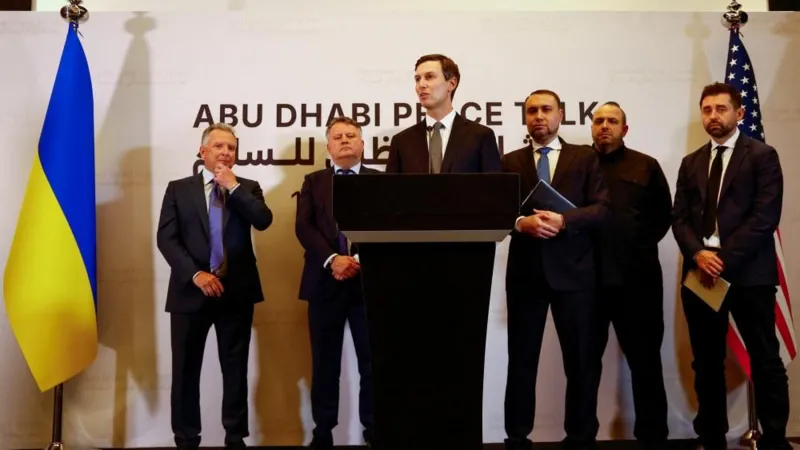
After a second day, trilateral negotiations between the US, Russia, and Ukraine in Abu Dhabi to settle the conflict in Ukraine have come to a conclusion.
There was little sign of any progress to put an end to the nearly five-year conflict that Russia’s invasion had caused, despite the American side claiming to see “some openings”.
The first session of negotiations since February, according to Davyd Arakhamia of Ukraine’s negotiating team, “was one of the hardest.”
Quick Facts
| Detail | Information |
|---|---|
| What Happened | Ukraine and Russia held peace negotiations. |
| Location | Abu Dhabi |
| Key Participants | Ukraine, Russia, United States and European representatives. |
| Main Issues | Territorial disputes, NATO influence and security guarantees. |
| Major Dispute | Control of Ukraine's eastern Donetsk region. |
| Prisoner Exchange | Both sides confirmed that an exchange was being prepared. |
| Current Status | Negotiations face major disagreements, with further diplomatic talks planned. |
Russia Ukraine Peace Talks Face Challenges
“I believe the Russians came with very strict directives, so it was extremely difficult to soften the discussion,” he stated. However, he noted that he felt “good momentum” and called for the prompt scheduling of a second round of negotiations.
Following the negotiations, it was revealed that US negotiators Steve Witkoff and Jared Kushner, the son-in-law of President Donald Trump, will visit Moscow on Thursday to meet with Russian President Vladimir Putin before traveling to Dublin.
Ukraine and Russia Seek Security Guarantees
Even though Ukraine is not a member of NATO, Kyiv may receive guarantees that its partners will support it if it is attacked once more.
It will probably involve limiting NATO’s influence in eastern Europe, which has been a major worry for the Kremlin since the alliance’s eastward expansion.
While Kremlin negotiator Vladimir Medinsky stated that the world required a “new” and “fair” security system earlier this week, Kushner stated that the US aimed to “create a new framework” of security between Ukraine, Russia, and Europe that could “secure lasting peace.”
Europe Seeks Role in Ukraine Peace Talks
The US and Ukrainian negotiators met with representatives of Britain, NATO, and many EU nations in Abu Dhabi, but the Kremlin, with whom the EU does not formally communicate, said that its team had not spoken to them.
Although Europeans have long maintained that they are essential to any post-war dynamics on their continent, Moscow has dismissed European involvement.
Many believe that their security is connected to that of Ukraine, especially in eastern Europe. A spokesman for the German government stated on Wednesday that agreements cannot be carried out “if no consensus can be reached among Nato members.”
Territorial Disputes Remain Key Peace Obstacle
There is also debate over whether a ceasefire should precede talks on a new security framework, as Kyiv and the Europeans would prefer, or whether the fighting should only end once a deal has been reached, as the Kremlin has maintained.
However, Kushner pointed out that any agreement on a security framework for peacetime is dependent on the end of the war.These transactions are extremely difficult and intricate, and this one is particularly sophisticated and emotionally charged, according to Kushner. “The reality is there is no trust right now between the sides and that is to be expected after a conflict like this.”