
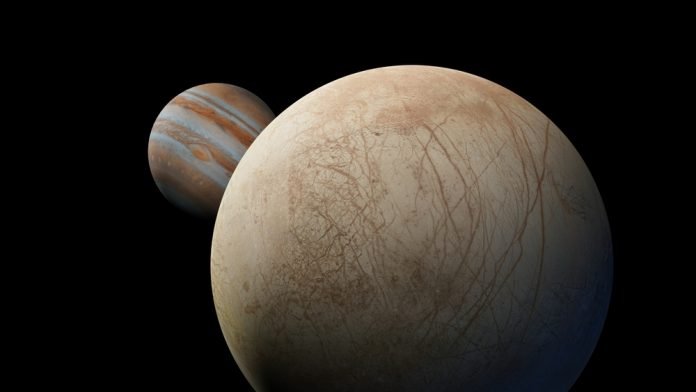
Study suggests nutrients could reach Europa’s ocean
Geophysicists at Washington State University have proposed a pathway for nutrients to reach the subsurface ocean of Europa, Jupiter’s icy moon. This ocean is a leading candidate for extraterrestrial life in our Solar System.
Scientists have long wondered how nutrients might move from Europa’s surface into its ocean, where microscopic life may exist.
Crustal delamination as a potential mechanism
The team focused on a geological process called crustal delamination. Using computer models, they showed that dense, nutrient-rich ice can separate from surrounding ice and sink into the ocean.
Austin Green, the study’s lead, said, “This idea is inspired by well-understood Earth processes. It addresses a longstanding habitability problem on Europa and improves the prospects for life in its ocean.”
Challenges for life under the ice
Europa’s ocean contains more water than all of Earth’s oceans combined, but it lies beneath a thick ice shell that blocks sunlight. Any life in this ocean would need nutrients and energy sources other than the Sun.
Jupiter’s intense radiation interacts with surface salts, creating nutrients that ocean microbes could use. Yet scientists are unsure how this surface ice reaches the ocean. Most of Europa’s ice moves sideways rather than downward, limiting surface-ocean exchange.
Weakening the ice to allow sinking
To solve this problem, researchers drew on Earth science. Crustal delamination occurs when dense crust detaches and sinks into the mantle. On Europa, regions of ice enriched with salts are denser and less stable.
The team proposed that saltier, denser ice, surrounded by purer ice, could sink into the shell. Their computer models showed that nutrient-rich ice can descend to the base of the ice shell if the surface ice is at least slightly weakened.
This process could consistently recycle ice and provide nutrients to Europa’s ocean.
Supporting the Europa Clipper mission
The findings align with the goals of NASA’s Europa Clipper mission, launched in 2024. The spacecraft is designed to study Europa’s ice shell, ocean, and potential to support life using advanced scientific instruments.