
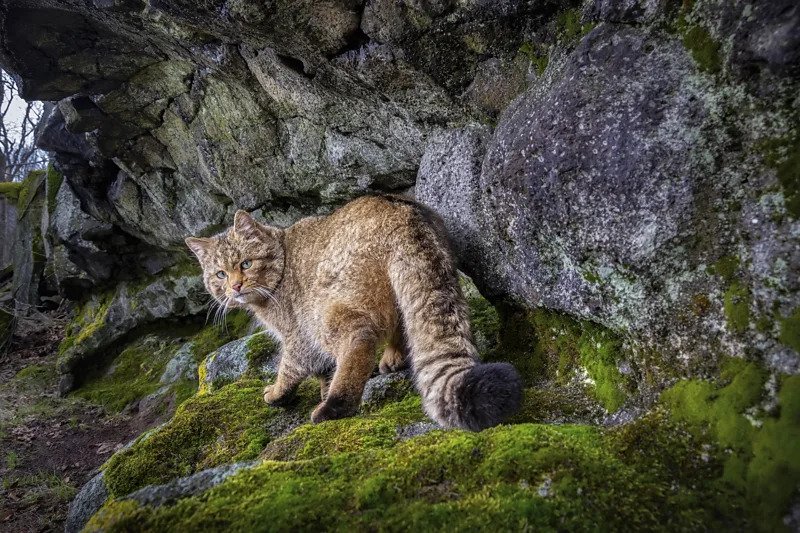
The European wildcat, one of Europe’s most elusive animals, is quietly returning to its natural habitats. Once thought to be gone from parts of Europe, these rare cats are now being seen again, and photographers are capturing incredible images of them.
In 2020, wildlife photographer Vladimír Čech Jr explored the snowy, remote Doupov Mountains in the Czech Republic.
“The wildcat is a mysterious creature, living a life full of riddles,” Čech says. With its thick, bushy tail and striped coat, it looks like a bigger, wilder version of a domestic tabby cat.
Historically, wildcats were common throughout the Czech Republic until the 18th century. But hunting and changes in the landscape gradually wiped them out. The last confirmed wildcat in the country was recorded in 1952. Modern sightings only began in 2011 when a camera trap in the Šumava Mountains captured one. Since then, experts like Jiri Sochor have monitored the Doupov Mountains, recording occasional sightings.
To capture these rare cats, Čech and Sochor built custom camera traps using sensors, cameras, and remote controls. “I made a small photo studio in the middle of the forest,” Čech explains. The photos are valuable for conservation, helping raise awareness about this elusive species and its protection.
Wildcats are difficult to track because they do not follow regular paths like other forest animals. Italian photographer Andrea De Giovanni discovered this while filming wildlife in the abandoned village of Chiapporato. Hoping to capture wolves or deer, he instead filmed a wildcat moving quietly through the snow. At first, he wasn’t sure if it was a domestic or wildcat, but experts confirmed it as the European wildcat.
Chiapporato, once home to lumberjacks and charcoal makers, is now empty and overgrown. De Giovanni sees the wildcat as a symbol of wildlife returning to areas humans have left behind. “As people leave, animals like wolves and wildcats start to come back,” he says.