
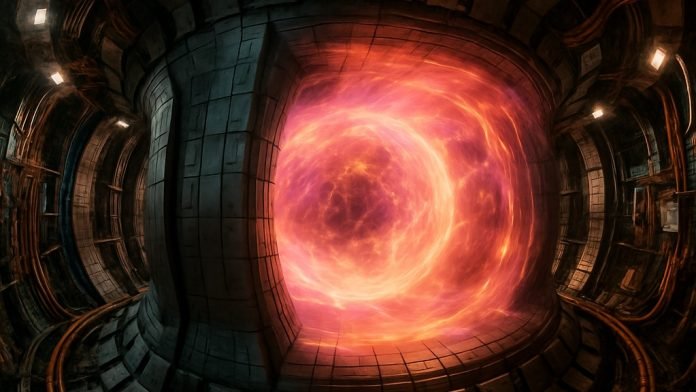
Fusion energy: Powering the stars on Earth
Nuclear fusion, the same process that powers the Sun, is gaining attention as a potential source of clean, virtually limitless energy. Unlike fission, which splits heavy atoms and creates long-lived radioactive waste, fusion joins light nuclei, like hydrogen isotopes, to release enormous energy. Fusion produces minimal waste, no carbon emissions, and relies on abundant fuel.
With growing energy demand and climate challenges, fusion is moving from theory to practical research, with breakthroughs bringing it closer to commercial use.
The history of fusion research
Fusion science began with the study of stars. In the 1920s, Arthur Eddington proposed that hydrogen fuses into helium to power the Sun. This was confirmed decades later by Hans Bethe in 1939, explaining stellar energy.
Post World War II, fusion research accelerated, initially driven by nuclear weapons programs. Later, peaceful applications became the focus. In the 1950s, the Soviet Union developed the tokamak, a doughnut-shaped device using magnetic fields to contain plasma. Tokamaks remain the leading fusion design today.
Significant milestones include the Joint European Torus (JET) producing 16 megawatts of fusion power in 1997, and the US National Ignition Facility (NIF) achieving net energy gain in 2022, a historic scientific breakeven.
How fusion works
Fusion combines light nuclei into a heavier nucleus, releasing energy because the resulting mass is slightly less than the sum of the parts. This “lost” mass converts into energy (E=mc²).
The most practical reaction uses deuterium and tritium. Fusion of these nuclei produces helium, a neutron, and 17.6 MeV of energy. Deuterium is abundant in seawater; tritium can be generated from lithium within the reactor. Managing tritium safely is challenging due to its radioactivity.
The energy from fusion is mostly carried by high-energy neutrons. These heat a surrounding blanket or coolant, producing steam to drive turbines, similar to conventional power plants.
Achieving fusion requires temperatures above 100 million degrees Celsius to overcome repulsion between nuclei. At such extremes, hydrogen becomes plasma, which must be contained using strong magnetic fields.
Fusion reactor technologies
Magnetic confinement fusion uses magnetic fields to hold plasma. Tokamaks, like ITER and JET, are the most studied devices. Stellarators twist the plasma chamber helically, allowing continuous operation without internal currents. Germany’s Wendelstein 7-X demonstrates this approach.
Inertial confinement fusion (ICF) compresses fuel pellets with lasers or ion beams. NIF in the US achieved the 2022 breakeven milestone using this method.
Private companies are exploring alternative designs: compact tokamaks, magnetized target fusion, and field-reversed configurations. They aim to simplify reactors, reduce costs, and speed commercialization.
Materials must withstand extreme heat, neutron bombardment, and electromagnetic fields. Research focuses on advanced alloys, tungsten, and silicon carbide composites to ensure durability and reduce long-term waste.
Flagship projects driving fusion forward
ITER (France) is the largest international collaboration, aiming for 500 MW output from 50 MW input (Q=10). While it won’t generate electricity, it will prove sustained net energy gain is possible.
JET (UK) continues to test fuel mixes and validate ITER’s design.
NIF (US) demonstrated fuel-level breakeven with lasers in 2022.
China’s EAST reached 160 million degrees for extended periods, feeding into plans for CFETR, a demonstration power plant with electricity generation expected by the 2040s.
South Korea’s KSTAR maintained plasma at 100 million degrees for 30 seconds, contributing to superconducting magnet technologies.
Germany’s Wendelstein 7-X stellarator achieved longer plasma durations, suggesting potential for continuous fusion energy.
Private sector innovations
Companies like Commonwealth Fusion Systems, Helion Energy, and TAE Technologies are pursuing high-field, pulsed, or alternative fuel fusion.
- SPARC and ARC (CFS) aim for net energy gain and grid-scale electricity by the 2030s.
- Helion plans commercial operation by 2030 and partnered with Microsoft to supply fusion power.
- TAE Technologies focuses on hydrogen-boron fuels, producing even cleaner outcomes.
- Other startups, including General Fusion, First Light Fusion, Zap Energy, and Kyoto Fusioneering, explore innovative designs and materials.
Economic and commercial challenges
Fusion reactors require large capital investment. ITER has exceeded €20bn in cost, and future commercial reactors may demand similar budgets.
Economic viability is measured by Levelised Cost of Electricity (LCOE). Future LCOE estimates vary but achieving competitive costs requires compact designs, durable materials, and modular construction. Private companies hope faster, smaller reactors will reach grid-competitive pricing sooner.
Safety and environmental impact
Fusion produces no greenhouse gases and far less radioactive waste than fission. Waste mainly comes from activated reactor components, with shorter half-lives. Advanced materials and recyclable components may further reduce environmental impacts.
When will fusion become practical?
Even with breakthroughs, commercial deployment is decades away. Experts estimate fusion will enter the energy mix in the 2040s or 2050s. Timelines could accelerate if private projects succeed. Challenges remain: regulatory approval, tritium supply, workforce training, and grid integration.
Fusion’s future outlook
Fusion represents one of humanity’s boldest scientific pursuits. From early stellar theory to modern breakeven experiments, the field has progressed rapidly. Public and private projects worldwide are pushing fusion toward practicality.
Though fusion alone won’t solve the climate crisis in the next two decades, it has the potential to become a major pillar of clean energy by mid-century. The progress today lays the foundation for a sustainable energy future powered by the reactions that light up the stars.