
At first glance, Willow doesn’t resemble the futuristic tech often imagined. There are no screens, no keyboards, no holographic displays or brain chips. Instead, it looks like a golden chandelier, a jellyfish of metal discs suspended above a bronze liquid helium bath, keeping the quantum chip just a fraction above absolute zero.
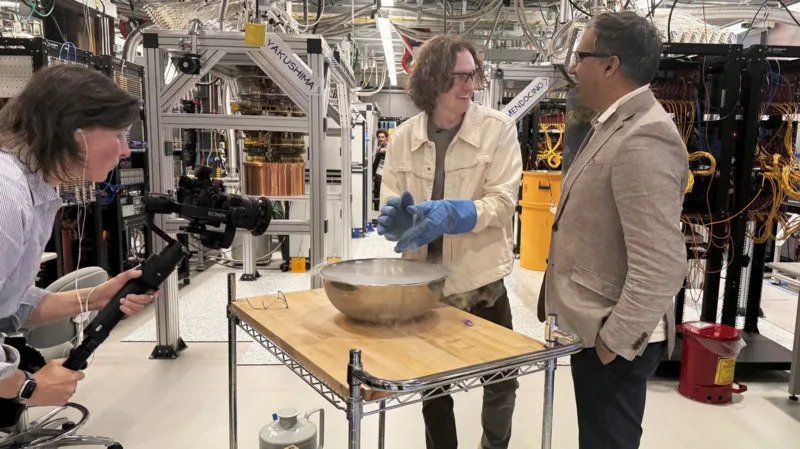
Hartmut Neven, Google’s Quantum AI chief, guides visitors through the lab with a mix of tech genius and artistic flair. Each quantum computer in the lab has its own name, from Mendocino to Yakushima, and is wrapped in contemporary art. Vibrant murals and sunlight from wide windows add a distinctly Californian touch to this high-security, high-tech environment.
A Leap Beyond Classical Computing
Willow has already achieved groundbreaking milestones. It solved a problem in minutes that would take the world’s fastest classical computer 10 septillion years—a number so large it dwarfs the age of the universe. This feat confirms that quantum computers can perform tasks impossible for classical machines.
With 105 qubits, Willow far outpaces competitors like Microsoft’s 8-qubit system. Researchers worldwide aim for a million qubits to create utility-scale quantum machines capable of advanced quantum chemistry, drug design, and more—all with error correction to ensure reliability.
Transforming Medicine, Energy, and AI
Neven envisions Willow’s potential for humanity. Quantum computing could accelerate medicine discovery, optimize food production, revolutionize energy storage and transport, and even help tackle climate change and hunger. Some experts predict that true Artificial Intelligence may only reach its full potential when combined with quantum computing.
The lab’s Nobel-winning team has pioneered superconducting qubits, the foundation for Willow. Error correction demonstrated here could allow quantum computers to perform a trillion operations within a decade—a timeline faster than previously expected.
The Global Quantum Race
Quantum computing is not just a tech story—it’s a geopolitical one. China has invested around $15 billion into quantum technology, consolidating talent and resources in a state-run enterprise. Their Zuchongzhi 3.0 quantum computer recently opened for commercial use. Meanwhile, the UK is investing heavily in quantum research, aiming to become a global leader alongside the US and China.
The Mind-Bending Science
Quantum computers operate on principles radically different from classical computers. Imagine opening a thousand drawers simultaneously instead of one at a time. This parallel processing is what makes quantum machines exponentially more powerful. Some researchers even speculate Willow’s speed hints at connections to parallel universes, though this remains theoretical.
Looking Ahead
While these computers will never fit into laptops or phones, their exponential power will change industries, economies, and security. From decrypting state secrets to safeguarding cryptocurrencies, Willow represents the dawn of a new quantum era. The first half of the 21st century was shaped by the internet and AI—the next 25 years may belong to quantum computing.