
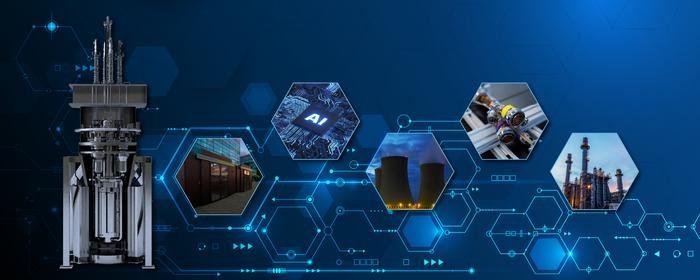
The push to deploy nuclear microreactors has moved beyond theory. It is now entering real-world testing.
Idaho National Laboratory has taken a major step by naming the first end-user experiments for its Microreactor Application Research Validation and Evaluation programme, known as MARVEL.
Through this effort, INL will test how ultra compact reactors can power AI data centres, support remote operations, improve reactor monitoring, and supply clean heat for desalination. As a result, the programme shows how microreactors could shape energy security, computing, and water systems in the coming years.
A testbed built for real use
At the centre of the programme is the MARVEL microreactor, developed by the US Department of Energy.
The reactor uses a sodium-potassium coolant and produces about 85 kilowatts of thermal power. It can also generate up to 20 kilowatts of electricity.
Although small, MARVEL is designed to prove that microreactors can run safely and reliably in demanding settings. Importantly, it focuses on flexibility rather than scale.
INL will install MARVEL at its Transient Reactor Test Facility. This gives private companies and researchers access to a working nuclear microreactor.
Because of this setup, partners can move past models and simulations. They can instead test real equipment under real operating conditions.
Supporting AI-driven data centres
One key focus is data centre power, especially for artificial intelligence workloads.
These facilities need steady electricity around the clock. In many locations, the grid cannot meet that need.
Amazon Web Services plans to study how MARVEL could work with modular data centres. These units are designed for rapid deployment and independent operation.
Such systems could support defence, government, and emergency missions. They would also reduce reliance on diesel fuel and fragile supply chains.
At the same time, DCX USA and Arizona State University will examine how microreactors can deliver constant power tuned to AI processing needs.
Together, these efforts will produce data on whether microreactors can support future high-performance computing.
Improving remote and autonomous operations
MARVEL will also help advance how reactors are operated.
GE Vernova plans to test remote and autonomous control concepts. This work aims to define standards that could later support commercial reactors.
As a result, operators may manage future systems with fewer staff on site. This capability is critical for remote or high-risk locations.
Strengthening safety with better sensors
Safety remains a central goal of the programme.
Radiation Detection Technologies will test advanced sensors on MARVEL. These instruments track reactor behavior in real time.
By improving visibility into reactor conditions, the technology can enhance safety and response. Over time, these insights may shape how regulators inspect and oversee microreactors.
Using nuclear heat for water treatment
Another application focuses on water.
Shepherd Power, NOV, and ConocoPhillips plan to use MARVEL’s heat for a pilot desalination project.
Their goal is to treat produced water from oil and gas operations. This water often contains contaminants and is costly to manage.
If the test succeeds, microreactors could offer a low-carbon option for water treatment in energy-intensive industries.
From selection to demonstration
Next, the selected teams will work with DOE and national laboratory experts. Together, they will refine designs and confirm technical feasibility.
After this phase, only some projects will advance to full reactor demonstrations. INL expects to announce final agreements and confirmed tests in 2026.
By opening MARVEL to industry and academia, INL is turning microreactors into practical tools. The programme shows how advanced nuclear systems can support AI growth, industrial strength, and environmental solutions. It also reinforces the United States’ role in nuclear innovation.