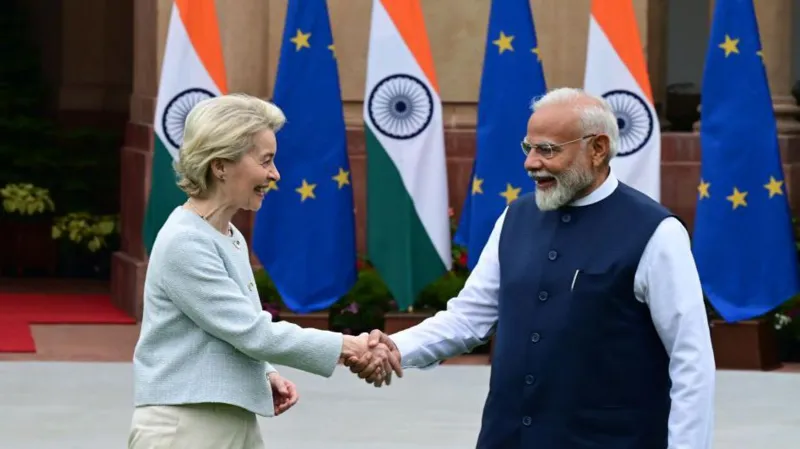
Next Monday, Ursula von der Leyen, President of the European Commission and Antonio Costa as President of the European Council. Both leaders will focus their attention on the progress of long-term free trade negotiations with India. These talks have been ongoing for almost two decades.
The timing of this diplomatic engagement is critical for Europe. Donald Trump, the U.S. president, initially threatened to increase tariffs against European.
He later backed down. Analysts view the EU-India Summit as an indication of Delhi’s desire to have a more balanced foreign policy, and less dependence on unreliable trade partners.
Von der Leyen, as well as India’s trade minister Piyush Ghoyal, have both called the deal the “mother of deals,” stressing the importance.
This deal, for India, will be its ninth in the last four years following agreements signed with Oman, the UK and New Zealand. The EU builds upon recent agreements with Mercosur and Japan as well as South Korea and Vietnam.
Analysts believe the agreement will help both sides to find reliable trading partners in the face of geopolitical uncertainty, as India seeks to counterbalance U.S.
EU believes that India needs to have closer economic ties due to its rapidly expanding economy.Von der Leyen said that India’s rapid growth would allow for a market with two billion people and a quarter global GDP.
The EU has already been India’s largest trading partner, and this agreement may restore Generalised System of Preferences, which removes import taxes on goods from developing nations.
This affected many Indian exports. This new agreement would reduce tariffs for key products such as pharmaceuticals, garments, steel machinery and petroleum. Tariff pressures.
Challenges remain. The EU wants stronger protections for intellectual property, improved data protection and more stringent patent standards.
Analysts believe that despite these obstacles, the agreement could improve trade resilience on both sides. The deal could create more predictability in the trading environment. India’s reduced imports of Russian crude in 2025 could also make the Europeans more willing to approve the deal. Political tensions between the U.S. and the EU may encourage them.
This historic EU-Indian trade agreement represents more than just economic gains. It also shows a commitment to building stronger and broader global partnerships.