
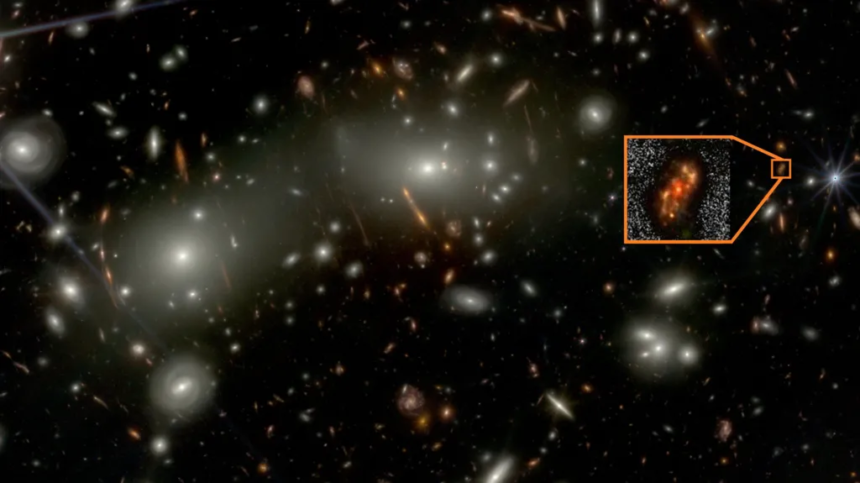
Indian astronomers have identified a surprisingly mature, Milky Way–like spiral galaxy dating back nearly 12 billion years, a period when the Universe was only 1.5 billion years old. This discovery, made using the James Webb Space Telescope (JWST), challenges long-held beliefs about how early galaxies formed after the Big Bang.
Researchers Rashi Jain and Prof. Yogesh Wadadekar from the National Centre for Radio Astrophysics (NCRA-TIFR) found a brilliantly structured spiral galaxy they’ve named Alaknanda, after a Himalayan river. The galaxy’s structure looks strikingly similar to the Milky Way, despite existing during a time called cosmic dawn, previously thought to be chaotic and dominated by small, irregular galaxies.
Jain spotted the galaxy while examining data from about 70,000 cosmic objects gathered by JWST. Alaknanda stands out as a “grand design spiral galaxy,” stretching nearly 30,000 light-years and featuring two beautifully symmetrical spiral arms wrapped around a bright central core.
Prof. Wadadekar said he was initially stunned by the find, noting that such a large and orderly galaxy forming so soon after the Big Bang goes against standard theories. Alaknanda contains around 10 billion stars and is producing new stars at a rate 20–30 times faster than the Milky Way today.
Since JWST began operations, astronomers have been uncovering more distant and detailed galaxies than ever before. The discovery of a fully formed spiral galaxy this early in cosmic history suggests that the Universe may have matured faster than previously thought.
Although we see Alaknanda as it was 12 billion years ago, its current state remains unknown. As Prof. Wadadekar joked, we would have to “wait another 12 billion years” to know what it looks like now. The research team now plans to request follow-up observations using JWST or the ALMA observatory in Chile to better understand how such a young galaxy formed its spiral arms.