
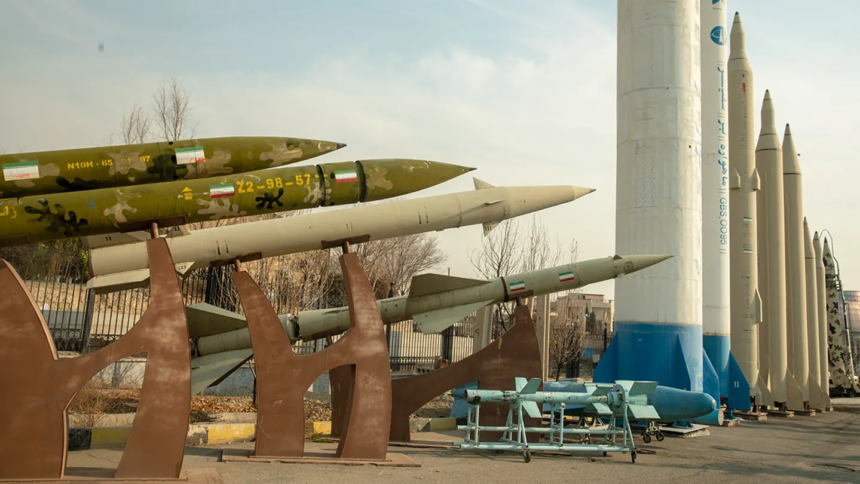
President Donald Trump recently warned that Iran is developing missiles that could one day threaten the United States. While Tehran does not currently possess a missile capable of striking the U.S. homeland, its existing arsenal already puts American forces across the Middle East within range.
Western defense analysts widely assess that Iran operates the largest ballistic missile force in the region. Most of its systems are short and medium range missiles capable of traveling up to about 2,000 kilometers, or roughly 1,200 miles.
US Bases Within Range in the Gulf
That distance covers a large network of American military sites in the Gulf.
Key installations inside that range include Al Udeid Air Base in Qatar, which serves as the forward headquarters for U.S. Central Command, and Naval Support Activity Bahrain, home to the U.S. Fifth Fleet. Camp Arifjan and Ali Al Salem Air Base in Kuwait also fall within reach, along with Prince Sultan Air Base in Saudi Arabia and Al Dhafra Air Base in the United Arab Emirates. In addition, Muwaffaq Salti Air Base in Jordan hosts U.S. aircraft and remains inside Iran’s strike envelope.
Although U.S. forces have reduced their presence at some regional sites, including handing over Al Asad Air Base in Iraq earlier this year, major Gulf hubs remain exposed to Iran’s missile capability.
Meanwhile, the United States has increased its military posture in response to rising tensions. The USS Abraham Lincoln Carrier Strike Group is operating in the Arabian Sea, while additional destroyers patrol the eastern Mediterranean, Red Sea, and Persian Gulf. The USS Gerald R. Ford Carrier Strike Group is also moving toward the region. U.S. fighter aircraft, including F-15s, F-16s, F-35s, and A-10s, are stationed across Jordan, Saudi Arabia, and Bahrain.
Can Iran Strike Europe?
Most publicly known Iranian missile systems top out at around 2,000 kilometers. Depending on launch points, that range could place parts of southeastern Europe, such as Greece, Bulgaria, and Romania, within reach.
However, hitting deeper into Europe would require longer range systems than Iran has demonstrated so far.
Can Iran Hit the United States?
At present, Iran does not field an operational intercontinental ballistic missile. To strike the U.S. East Coast, a missile would need a range of roughly 10,000 kilometers, far beyond Iran’s known capabilities.
That said, U.S. intelligence agencies have warned that Iran’s space launch program could provide the building blocks for a future long range missile. The Defense Intelligence Agency has assessed that Iran could develop a militarily viable ICBM by 2035 if its leadership chooses to pursue that path.
Recent space launches using solid fuel rockets have drawn particular attention. Solid fuel technology allows faster launch times and is commonly used in military missile systems. Because space launch vehicles and long range missiles share similar multi stage rocket technology, progress in one area can support advances in the other.
For now, though, the U.S. homeland remains outside the reach of Iran’s current missile inventory.
Missile Defenses and Strategic Concerns
The United States relies on layered defense systems such as THAAD, Patriot batteries, and ship based interceptors to protect troops and allies in the region. These systems are capable, but interceptor stockpiles are limited.
Defense analysts note that high intensity exchanges could strain inventories over time. In addition, advanced interceptors are significantly more expensive than many of the short range missiles they are designed to stop.
Beyond military readiness, Iran’s missile program complicates diplomacy. Secretary of State Marco Rubio has described Tehran’s refusal to negotiate limits on its missile arsenal as a major obstacle in talks focused on nuclear activities. Iranian officials, however, maintain that their missile program is defensive and not open for negotiation.
As discussions continue, one fact remains clear. Iran cannot currently strike the U.S. homeland. Still, American forces across the Middle East operate within range of Tehran’s existing missile systems, and future developments remain under close watch.