
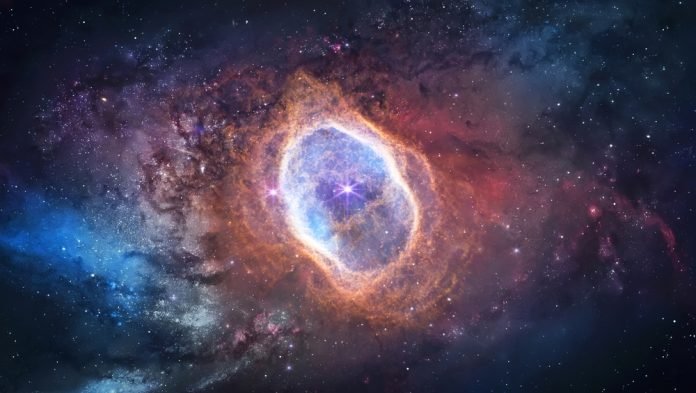
Astronomers Find Rare Iron Structure in the Ring Nebula
UK-led astronomers have discovered a long, iron-rich structure hidden inside the famous Ring Nebula. The finding offers a new view into how dying stars shape their surroundings.
Researchers from Cardiff University and University College London led the work. Notably, this marks the first time scientists have seen a feature like this inside the nebula.
The structure appears as a thin bar of iron atoms. It sits neatly within the inner region of the nebula’s oval shell.
A Structure of Remarkable Scale
The iron bar is vast. It stretches around 500 times the distance between the Sun and Pluto. In addition, the total amount of iron matches the mass of Mars.
Because of its size and composition, the feature surprised the research team. Until now, no telescope had detected it.
A Well-Known Nebula With New Secrets
French astronomer Charles Messier first recorded the Ring Nebula in 1779. It lies in the constellation Lyra and remains one of the most studied objects in the night sky.
The nebula formed when a star expelled its outer layers near the end of its life. Our Sun will follow a similar path billions of years from now.
Over time, astronomers have imaged the nebula many times, including with the James Webb Space Telescope. However, the iron bar stayed hidden until this new study.
How Scientists Made the Discovery
The team used WEAVE, a new instrument on the William Herschel Telescope in the Canary Islands. WEAVE allows astronomers to collect light data from every point across an object.
Using its Large Integral Field Unit mode, the team mapped the nebula across all visible wavelengths. As a result, they could track chemical elements in precise detail.
This method gave scientists their first full chemical map of the Ring Nebula.
A New Way to Study Old Objects
Dr Roger Wesson from UCL and Cardiff University led the analysis. He explained that many telescopes have studied the nebula before. However, WEAVE offered a different approach.
By collecting continuous spectra across the nebula, the team could create images at any wavelength. This also allowed them to identify elements at specific locations.
As a result, the iron bar finally became visible.
Where Did the Iron Come From?
Despite the discovery, the origin of the iron bar remains unclear. Scientists are testing two main ideas.
First, the parent star may have ejected its material in an unusual pattern. Alternatively, the iron could come from a rocky planet destroyed as the star expanded.
Professor Janet Drew from UCL noted that more data is needed. In particular, the presence of other elements near the iron could help explain how it formed.
What Comes Next
The team plans further observations using WEAVE at higher resolution. These studies will examine the iron bar in greater detail.
At the same time, researchers want to see if similar structures exist in other nebulae. This could show whether the Ring Nebula is unique or part of a wider pattern.
WEAVE is already running several major surveys across the Milky Way and beyond. One survey focuses on ionised nebulae and is led by Professor Drew.
Dr Wesson believes this discovery may be the first of many. As astronomers gather sharper data, more hidden features may come to light.
Ultimately, the iron bar adds a new layer to our understanding of how stars end their lives and what they leave behind.