
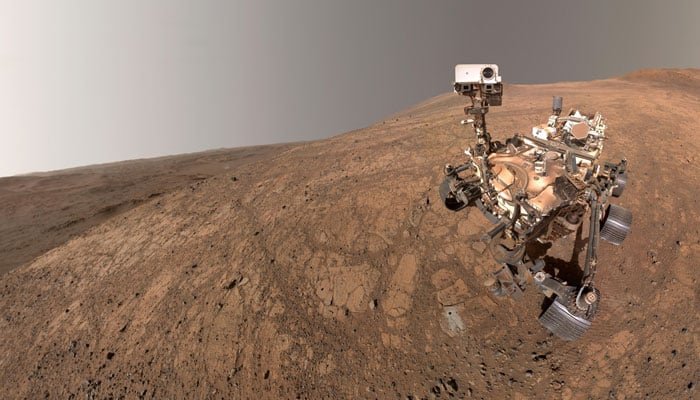
NASA’s Perseverance rover has made a groundbreaking discovery: Mars experiences tiny electrical discharges, or “mini-lightning,” in its thin atmosphere. These sparks, captured by the rover’s SuperCam instrument, are often linked to dust devils—whirlwinds that sweep across the Martian surface.
This marks the first direct evidence of electrical activity on Mars. Planetary scientist Baptiste Chide of France’s Institute for Research in Astrophysics said the finding could have major implications for understanding Mars’ climate, atmospheric chemistry, and the safety of future robotic and human missions.
Over two Martian years, Perseverance recorded 55 mini-lightning events in 28 hours of audio and electromagnetic data. Unlike Earth lightning, these sparks are tiny—just a few centimeters long—but produce audible “whip-crack” sounds. They are caused by triboelectricity, where dust particles rubbing together build up an electrostatic charge.
“These sparks are similar to the tiny shocks you might feel when touching a doorknob after walking on a carpet,” explained Franck Montmessin of CNRS and LATMOS. Dust devils on Mars are common and can reach wind speeds of up to 98 mph, making electrical discharges more likely than on Earth.
This discovery puts Mars alongside Earth, Jupiter, and Saturn as planets with confirmed atmospheric electricity, hinting that other planets and moons like Venus, Uranus, and Titan could also experience similar phenomena. Since landing in 2021, Perseverance has been listening to the Red Planet, compiling over 30 hours of Martian sounds—from wind howls to helicopter blades—and now, mini-lightning sparks.
#MarsDiscovery #PerseveranceRover #MiniLightning #MarsAtmosphere #DustDevils #SpaceExploration #NASA