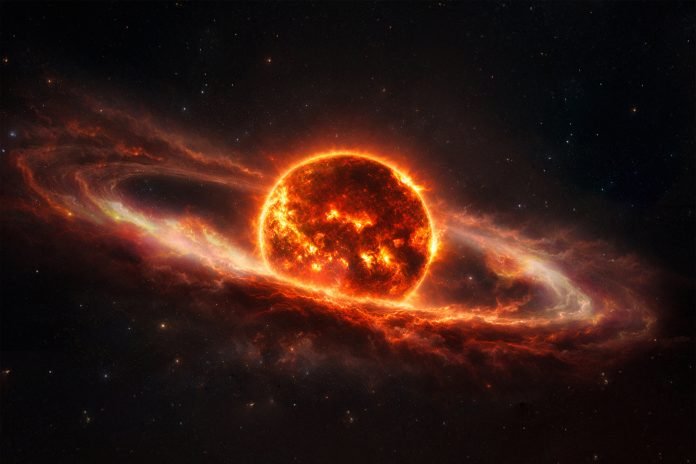
Scientists at the Carnegie Institute for Science are studying a new way to understand space weather around M dwarf stars. Their work focuses on plasma rings that form around some of these stars early in their lives.
M dwarf stars are smaller and cooler than the Sun. Most host at least one rocky, Earth-sized planet. However, many of these planets face harsh conditions. Some are too hot for liquid water. Others lose their atmospheres due to frequent stellar flares and strong radiation.
Even so, these systems still offer valuable insight into how stars affect their planets.
How Stars Shape Planetary Environments
Stars influence planets in two main ways. First, they emit light, which scientists can observe easily. Second, they release space weather such as stellar winds and magnetic storms. These effects are harder to study, especially at large distances.
According to lead researcher Luke Bouma, understanding space weather is key. It helps explain how planets evolve and whether they can support stable environments.
Unusual Brightness Dips Hold the Answer
Bouma worked with Moira Jardine from the University of St Andrews to study a rare type of M dwarf. These stars rotate quickly and show regular dips in brightness.
At first, astronomers did not know what caused these dips. Some thought starspots were responsible. Others suspected orbiting material.
To solve the mystery, the team created detailed spectroscopic movies of one star. As a result, they found large clumps of cool plasma trapped by the star’s magnetic field. Together, these clumps form a ring-shaped structure called a torus.
Plasma Rings Act as Space Weather Stations
Once identified, the plasma torus revealed much more than expected. It acts like a natural space weather station near the star’s surface.
The torus shows where plasma collects, how it moves, and how strongly the star’s magnetic field controls it. Because of this, scientists can track space weather conditions with far greater detail.
The researchers estimate that at least 10 percent of M dwarf stars develop these plasma rings early on. Therefore, many stars may offer similar tools for studying stellar activity.
What This Means for Planetary Habitability
Space weather plays a major role in shaping planetary atmospheres. Strong stellar winds can strip gases away. Over time, this may leave planets barren.
By studying plasma rings, scientists can better understand how particles flow from stars to planets. This knowledge may help explain why some planets survive harsh conditions while others do not.
What Comes Next
Next, the research team plans to trace the source of the plasma. They want to know whether it comes from the star itself or from an external object.
Bouma describes the finding as unexpected but valuable. Although scientists still do not know if planets around M dwarfs can support life, this discovery opens a new path. Understanding space weather will likely play a central role in answering that question.