
STELLAR AI aims to speed up fusion research
A new US-led computing project seeks to remove one of the biggest barriers in fusion energy research. That barrier is the long time and massive computing power needed to model and improve fusion systems.
By combining artificial intelligence, supercomputing, and live experimental data, the project aims to speed up discovery across the fusion field. The platform is called STELLAR AI and is led by the Department of Energy’s Princeton Plasma Physics Laboratory.
Rather than acting as a single facility, STELLAR AI serves as a shared infrastructure. It connects national labs, universities, technology firms, and private fusion companies.
Breaking the fusion simulation bottleneck
Fusion research depends heavily on complex simulations. Scientists use them to predict plasma behaviour, test reactor designs, and refine operating conditions.
However, these simulations can take weeks or even months to complete. Training AI models for fusion research also requires large amounts of time and computing power.
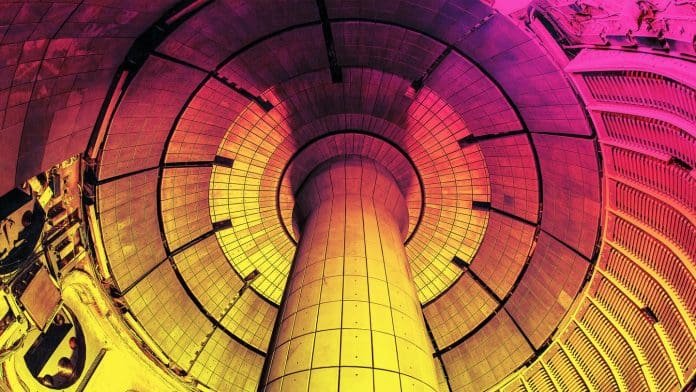
STELLAR AI tackles this problem directly. It links high-performance computing systems with active fusion experiments, including PPPL’s National Spherical Torus Experiment Upgrade. This machine is expected to restart operations later this year.
Because of this link, researchers can analyse data almost in real time. Instead of waiting until experiments end, they can adjust models and decisions as experiments run.
A digital platform built for fusion
STELLAR AI is designed specifically for the demands of fusion energy research. Fusion systems involve complex physics, strict engineering limits, and cost constraints. Optimising them requires both speed and accuracy.
To meet these needs, the platform combines several types of computing hardware. Central processors manage general tasks. Graphics processors accelerate AI workloads. In addition, quantum processors are included to explore problems that may benefit from quantum methods.
This mix creates a flexible system. It can handle plasma modelling, reactor design, and AI-driven optimisation within a single environment.
Digital twins and faster reactor design
One major goal of STELLAR AI is the creation of digital twins. A key example is a virtual version of the NSTX-U reactor.
This digital twin allows scientists to test control strategies and experiment plans in software first. As a result, risks fall, and experiments run more efficiently.
Another effort, known as StellFoundry, focuses on stellarators. These fusion devices use complex magnetic shapes that are difficult to design.
Traditionally, stellarator design can take years. With AI-guided optimisation on STELLAR AI, researchers expect to find strong designs much faster.
Part of a wider national AI strategy
STELLAR AI sits within the Department of Energy’s Genesis Mission. This national effort aims to speed up scientific progress through artificial intelligence.
Genesis provides access to top-level supercomputers, experimental facilities, shared data, and advanced AI models. Within this framework, STELLAR AI contributes fusion-focused tools, datasets, and simulation codes.
The project also supports goals set out in the Fusion Science and Technology Roadmap. That plan calls for digital platforms to help bring fusion energy closer to commercial use.
Strong links between the public and private sectors
Collaboration is central to STELLAR AI. The project brings together national laboratories, universities, global technology firms, and private fusion companies.
Universities contribute to research and training. Technology firms supply hardware and computing expertise. Fusion companies gain access to AI tools that support reactor development and shorten timelines.
Because of this structure, progress made through STELLAR AI can move quickly from research to industry.
Advancing the future of fusion energy
By uniting AI, supercomputing, and live experiments, STELLAR AI marks a major step forward for fusion research.
If successful, it could shorten development cycles, reduce costs, and bring practical fusion power closer to reality. In doing so, it supports the long-term goal of clean and abundant energy.