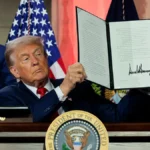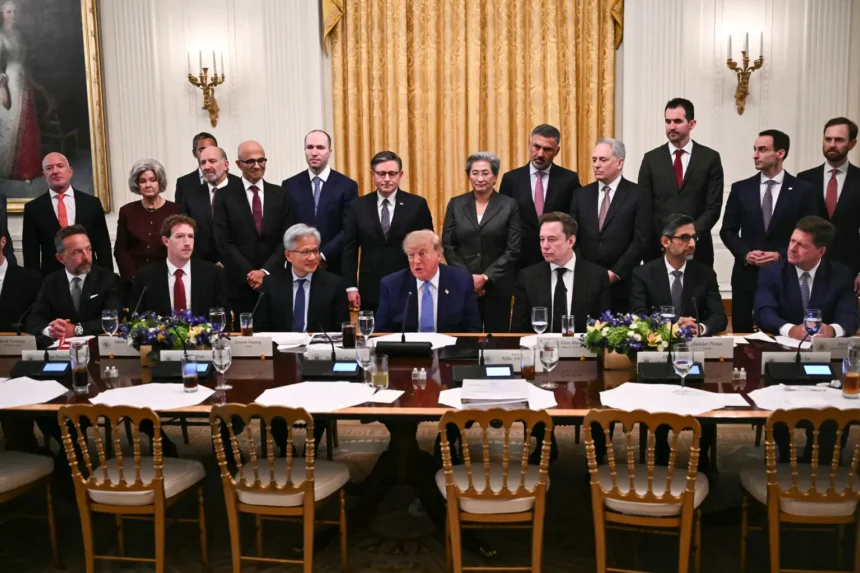
A voluntary agreement on artificial intelligence safety has been signed by President Donald Trump and a number of prominent technology executives.
The pact requests that businesses creating cutting-edge AI systems utilize independent evaluations, bolster internal controls, and give their boards more authority over safety. The agreement does not establish new federal legislation or specify legal repercussions for businesses that violate it.
Quick Facts
| Detail | Information |
|---|---|
| What happened? | Trump and major technology leaders signed a voluntary AI safety accord. |
| Where? | White House, Washington, D.C. |
| When? | September 29, 2026 |
| Who is involved? | Donald Trump and leaders from Meta, Google, Anthropic, OpenAI, Nvidia and xAI. |
| Current status | Voluntary industry commitment. |
| Key focus | AI safety controls, monitoring, independent audits and board oversight. |
| Why it matters | The accord sets a shared framework for managing risks linked to advanced AI systems. |
Trump Announces Voluntary AI Safety Accord
The document carries the title “Joint Commitment on Frontier Responsibilities.” It asks companies that develop and deploy advanced AI models to create stronger safety processes.
Trump described the agreement as “morally binding.” However, reports on the published document say it does not establish legal enforcement measures. The companies instead make voluntary commitments to improve their safety systems.
Four Layers of AI Safety Controls
The pact defines four primary areas of supervision.
First, while developing and implementing cutting-edge AI models, businesses should uphold stringent internal controls. These controls ought to keep an eye on things like chemical hazards, biosecurity, and cybersecurity.
Second, businesses should establish internal teams to verify the effectiveness of such measures. These groups should also find issues and ensure that businesses deal with them.
Third, the businesses ought to collaborate with impartial outside auditors or assessors. These reviewers would determine whether the monitoring systems and safety measures function as planned.
Additionally, the involved firms also want to meet regularly.
These are the finest safety requirements. According to the agreement, formal laws or regulations may ultimately include these practices.
The agreement is still a voluntary industry commitment for the time being.
What Happens to the AI Accord?
The participating companies are expected to work on their internal safety systems and meet regularly to discuss common practices.
The agreement leaves open the possibility of future legislation or regulation. Whether governments eventually turn these voluntary principles into binding rules remains a separate policy question.
For now, the accord represents an industry commitment rather than a new federal AI law.
Trump and Tech Leaders Back AI Safety Plan
Trump and several major technology leaders have agreed to a voluntary framework for improving AI safety.
The plan calls for internal controls, dedicated monitoring teams, independent external reviews and board level oversight. Its future impact will depend on how companies apply these measures and whether policymakers later introduce formal rules.