
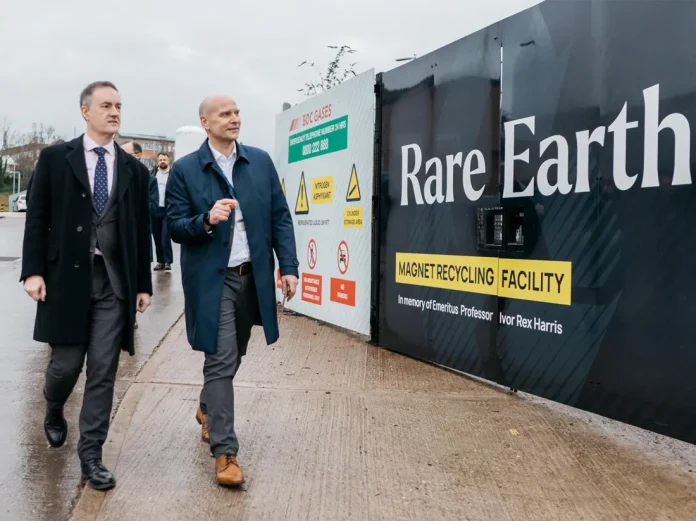
UK Launches Major Rare Earth Magnet Recycling Facility
The University of Birmingham has opened a new rare earth magnet recycling facility. The site aims to cut the UK’s reliance on imported rare earth metals and magnets.
Rare earth magnets play a vital role in modern technology. They are used in wind turbines, electric vehicles, medical devices, robotics, pumps, and electronics. As clean energy adoption grows, demand for these materials will rise further.
Because of this, securing a local supply has become a national priority.
Strengthening the UK’s Critical Minerals Supply
Professor Rachel O’Reilly, Pro Vice Chancellor for Research at the University of Birmingham, said the facility supports the UK’s push for long-term resilience.
She explained that circular supply solutions for critical minerals help the UK build leadership in advanced manufacturing. In addition, university-led research can translate directly into industrial capability and national sustainability goals.
The new facility highlights how research can move beyond the lab and into real-world production.
Policy Warnings Drove the Shift
In 2021, the Birmingham Centre for Strategic Elements and Critical Materials released a major policy report. The study warned that the UK faced growing risks as it moved from fossil fuels to electrification.
The report pointed to rising dependence on technology, critical metals such as lithium, cobalt, and rare earths. As a result, it urged action across recycling, processing, and global partnerships.
Importantly, the new facility responds directly to these recommendations.
First UK Magnet Production in 25 Years
The facility brings sintered rare earth magnet production back to the UK for the first time in 25 years. It supports both primary magnet production and recycled material processing.
This step reduces supply chain risk and helps rebuild domestic capability. It also supports the UK’s low-carbon industrial future.
A New Hydrogen-Based Recycling Process
Chris McDonald MP, Minister for Industry, officially opened the site. The facility uses a hydrogen-based process developed by University of Birmingham researchers.
Known as Hydrogen Processing of Magnet Scrap, the method extracts magnets from end-of-life products without full disassembly. As a result, it saves time, energy, and cost.
The process turns waste into usable material for new metals, alloys, and magnets. At the same time, it cuts environmental impact and supply risk.
Scaled for Commercial Production
The facility sits at Tyseley Energy Park in Birmingham. It scales the process to commercial levels for the first time.
Earlier trials handled 50 to 100 kilogram batches. Now, the site can recover more than 400 kilograms of rare earth alloy per batch.
On a single shift, it can produce up to 100 tonnes of new magnets each year. With multiple shifts, output can exceed 300 tonnes annually.
Major Carbon Savings
The facility recycles materials from hard drives, electric motors, wind turbines, pumps, robotics, and electronics.
By doing so, it cuts carbon emissions by around 90 percent compared to mining and refining raw materials. This delivers both environmental and economic benefits.
Part of a Broader Circular Economy Push
Rare earth recycling forms part of the University of Birmingham’s wider research strengths. These include battery recycling, robotic disassembly, chemical recovery, and energy storage.
Funding for the project totals £4.5 million from Innovate UK’s Driving the Electric Industrialisation Centres programme. Additional support came from EPSRC, the Advanced Propulsion Centre, Innovate Climate, and EU Horizon grants.
Together, this funding supports clean technology supply chains and the UK’s net zero goals.
Supporting Industry and Jobs
Bruce Adderley from Innovate UK said the project shows how research can move quickly into industry. He added that it helps reduce risk for UK manufacturers while improving sustainability.
Professor Allan Walton, who leads the Magnetic Materials Group, highlighted the wider impact. He said the facility will supply recycled materials across the UK value chain.
In addition, it will support job creation, skills development, and long-term economic growth.
Overall, the facility marks a major step toward a secure and sustainable rare earth supply for the UK.