
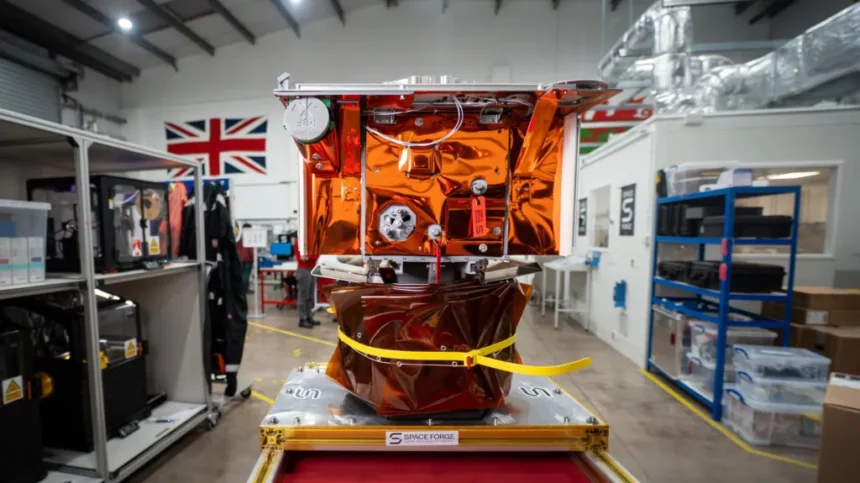
A factory orbiting Earth sounds like science fiction. However, a company based in Cardiff is turning this idea into real hardware.
Space Forge has sent a factory the size of a microwave into space. More importantly, the team has proven that its furnace can turn on and reach about 1,000 °C while in orbit.
This marks a major step toward making advanced materials in space instead of on Earth.
Why Space Is Ideal for Semiconductors
Space offers conditions that are hard to copy on the ground. For example, there is no gravity. Because of that, atoms inside semiconductor materials line up perfectly during production.
In addition, space is a natural vacuum. This prevents dust and other contaminants from entering the material.
As a result, the semiconductors produced in orbit are far purer and more precise. In simple terms, better structure means better performance.
Big Gains in Performance
According to Space Forge chief executive Josh Western, the difference is huge.
He says the company can make semiconductors up to 4,000 times purer in space than on Earth. That level of quality could improve many everyday technologies.
For instance, these materials could be used in 5G towers, electric vehicle chargers, and modern aircraft systems. Over time, they may also support faster computing and stronger communications networks.
First Images From Inside the Furnace
The factory launched on a SpaceX rocket during the summer. Since then, the team has controlled and tested it from their mission control centre in Cardiff.
Recently, the satellite sent back images from inside the furnace. The pictures showed glowing plasma, which is gas heated to about 1,000 °C.
For Veronica Viera, the payload operations lead, this moment stood out.
She said seeing the image was one of the most exciting moments of her life. More importantly, it proved that a key part of the manufacturing process works in space.
Next Step, A Larger Space Factory
Now that the basic system works, the company is moving forward. The next goal is to build a larger factory.
This upgraded version could produce enough material for around 10,000 semiconductor chips. At the same time, the team must prove they can safely return the material to Earth.
To do that, a future mission will use a heat shield called Pridwen. The name comes from the shield of King Arthur. Its role will be to protect the spacecraft during its return through Earth’s atmosphere.
A Growing Industry Above Earth
Space Forge is not alone in this effort. Other companies are also testing ways to make products in orbit, including medicines and artificial tissues.
According to Libby Jackson from the Science Museum, in space, manufacturing is already happening. Right now, production is small. Still, each successful test brings the industry closer to commercial use.
She says that once companies prove the technology, it opens the door to making useful products in space and bringing them back to Earth. That progress could benefit people everywhere.