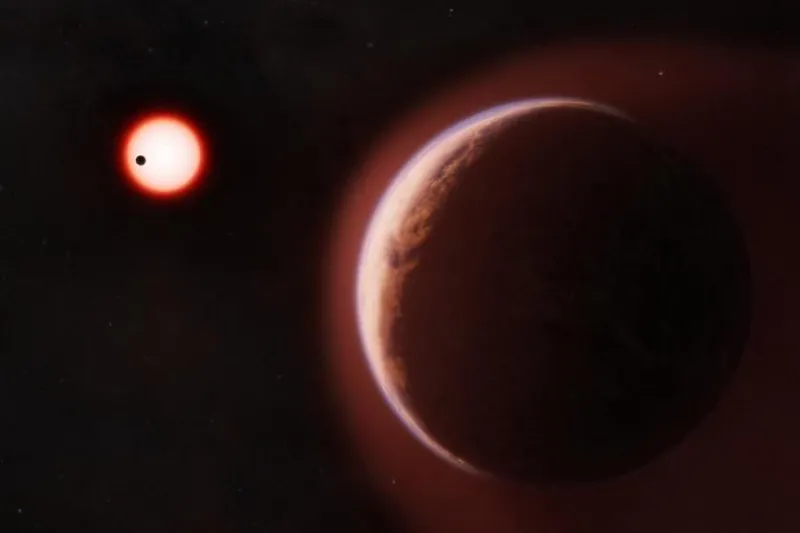
Scientists have reached an exciting milestone by discovering the first atmosphere surrounding an Earth like rocky planet located in the habitable zone of a distant star. The finding gives researchers stronger evidence that planets with conditions similar to Earth may exist elsewhere in the universe.
The planet, known as LHS 1140 b, lies about 48 light years away from Earth. It orbits a small, cool red dwarf star. Because the planet sits in the habitable zone, scientists believe temperatures there could allow liquid water to exist under the right conditions. Water is one of the key ingredients needed for life.
A Historic Discovery for Planet Research
Researchers detected helium in the planet’s atmosphere. While helium cannot support life on its own, its presence confirms that the rocky planet has an atmosphere. Scientists believe additional gases could exist closer to the planet’s surface, but more observations are needed to confirm this possibility.
Experts describe the discovery as an important breakthrough in the search for habitable worlds beyond our solar system. Finding an atmosphere around a rocky planet inside the habitable zone marks a major step forward for astronomy.
Why the Habitable Zone Matters
Astronomers often call the habitable region around a star the Goldilocks zone. A planet in this area is neither too hot nor too cold, making it possible for liquid water to remain on its surface.
Thousands of planets have been discovered outside our solar system. However, only a small number are rocky worlds located inside their star’s habitable zone. Until now, none had shown confirmed evidence of an atmosphere.
This latest discovery makes LHS 1140 b one of the most promising planets for future research. Scientists hope advanced telescopes will reveal whether gases such as water vapor, oxygen, methane, or carbon dioxide are also present.
The Search for Life Continues
Researchers emphasize that this discovery does not prove life exists on LHS 1140 b. Instead, it provides a better target for future studies. Understanding the planet’s atmosphere could help scientists determine whether the world has conditions suitable for life.
Astronomers continue to examine other distant planets as well. One example is K2 18b, a larger planet that previously attracted attention after researchers detected possible signs of dimethyl sulphide, a gas associated with marine organisms on Earth. Scientists are still studying those findings.
The discovery of an atmosphere around LHS 1140 b represents another important milestone in space exploration. Every new observation helps scientists understand how planets form, evolve, and whether life could exist beyond Earth.