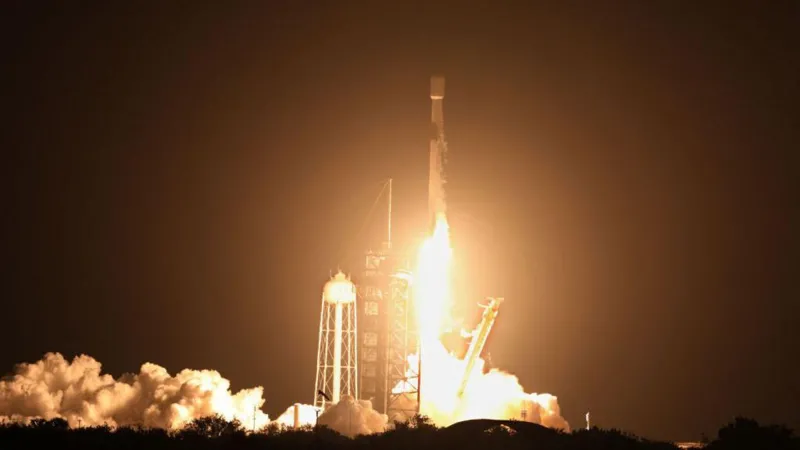
SpaceX Rocket Set to Hit Moon
Over millions of years, the Moon has suffered innumerable strikes. The satellite’s characteristic network of craters and pockmarked surface are the result of asteroids and meteors.
In more recent times, it has also been hit by the courageous little landers and probes that Earthbound space agencies have sent towards it.
NASA’s Center for Near-Earth Object Studies (CNEOS) reports that on August 5, the upper stage (section) of one of SpaceX’s Falcon 9 rockets will “impact” the Moon.
NASA Tracks SpaceX Rocket Collision
The US space agency came to this conclusion after independent astronomers discovered it. A section of a rocket from a January 2025 launch was inadvertently headed for the Moon using public data.
“Earth is not in danger,” spokeswoman Jimi Russell declared. “Nasa will continue to track the booster for training purposes, as well as later observe the impact site for scientific purposes.”
A portion of the Falcon 9 is reusable and intended to return to Earth for its subsequent mission.
A portion of the Falcon 9 is reusable and intended to return to Earth for its subsequent mission.
However, until they ultimately crash with another celestial body, portions of the rocket are shed in space and stay there.
The component in question is the rocket’s upper stage, which weighs at least 4,000 kg (8,800 lbs) on Earth and is about the size of a five-story skyscraper.
The item will land close to the Einstein Crater, which is on the portion of the Moon that receives daylight and is visible from Earth.
According to astronomer Bill Gray, who initially identified the track. He believes it will produce a crater with a diameter of more than 17 meters (56 feet).
SpaceX Impact Could Create Dust Plume
Both amateur and professional astronomers are likely to be enthralled with the approaching collision.
Something enormous is colliding with the moon. We can simply watch the program; it’s not at all unsafe,” explains Dr. Matt. Bothwell is a University of Cambridge public astronomer.
When it hits, a massive cloud of dust will be sent up, possibly 50 kilometers or more into the sky. It will eventually spread sideways, according to Bothwell.
Bothwell stated that the impact will be “more impressive than any [similar] explosion on Earth” due to the Moon’s lack of atmosphere and far less gravitational pull.
Telescopes Ready for Lunar Collision
Nothing will stop the estimated million kilos of debris from hurtling up into space, nor will it slow the item down as the atmosphere would on Earth.
According to Bothwell, the impact won’t be visible to the unaided eye from Earth. Those with access to an advanced telescope might be able to see a flare emanating off the Moon’s surface.
Bothwell pointed out that the impact’s potential for education would be more important.
According to him, this would be a rare chance to research what occurs when an object strikes the moon.
large American telescopes, as well as South Korea’s Danuri mission and NASA’s Lunar Reconnaissance Orbiter.