
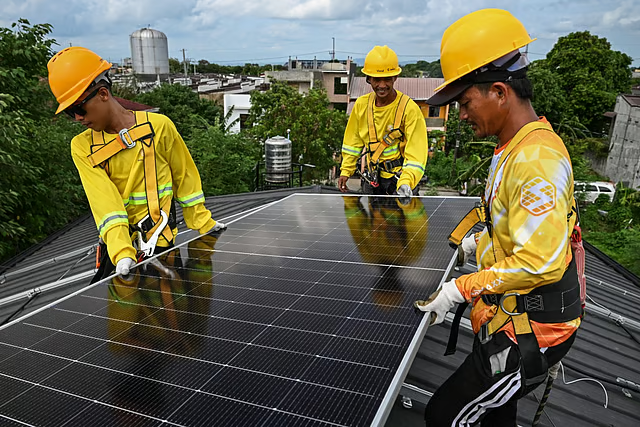
Rooftop solar is expanding rapidly in Pakistan and the Philippines as households and businesses look for cheaper and more reliable electricity.
High power bills, concerns about fuel supplies, and falling solar panel prices are encouraging more consumers to generate their own electricity. China remains the world’s biggest solar panel producer, accounting for about 80% of global production.
Quick Facts
| Detail | Information |
|---|---|
| Solar boom | Pakistan and the Philippines are seeing rapid growth in rooftop solar. |
| China's share | China produces about 80% of the world's solar panels. |
| Pakistan electricity costs | Electricity prices increased by about 150% over three years. |
| Philippines solar growth | Rooftop solar installations grew about five times in one year compared with the previous decade combined. |
| Philippines inquiries | Solar installers reported monthly inquiries rising from around 100 to 1,000 to 2,000. |
| Energy security | Many consumers are turning to solar to lower costs and reduce dependence on the power grid. |
Why Rooftop Solar Is Growing
The main reason behind the solar boom is economic pressure.
Electricity costs have increased sharply in both countries. As a result, consumers are looking beyond traditional power grids and considering solar as a way to reduce monthly energy expenses.
The Philippines and Pakistan have also become major markets for Chinese solar panels. They rank among the leading destinations for panels that are installed within the country rather than shipped elsewhere.
Pakistan Sees a Major Solar Shift
Pakistan has experienced a particularly rapid move toward rooftop solar.
Energy costs increased significantly after global fuel markets faced disruption following the Russia Ukraine war. Higher LNG costs and supply concerns added further pressure to the country’s power system.
According to Renewables First representative Zeeshan Ashfaq, electricity prices increased by around 150% over three years.
That increase has made solar power financially attractive for many households and businesses. Consumers can reduce their reliance on expensive grid electricity by producing power on their own rooftops.
Philippine Households Turn to Solar
The Philippines is also seeing strong growth in rooftop solar.
The country’s dependence on imported fossil fuels makes electricity prices vulnerable to international energy shocks. Its geography creates another challenge because power must travel across a vast archipelago.
Recent concerns about fuel shortages and possible electricity disruptions increased public interest in rooftop solar.
Solar Boom by the Numbers
| Figure | What it means |
|---|---|
| 80% | China's approximate share of global solar panel production. |
| 150% | Increase in Pakistan's electricity prices over three years. |
| 5 times | Growth in Philippine rooftop solar installations in one year compared with the previous decade combined. |
| 1,000 to 2,000 | Monthly solar inquiries reported by Philippine installers after the Strait of Hormuz crisis. |
| 12% | Approximate share of monthly household income spent on electricity in the Philippines. |
| 7,641 | Approximate number of islands in the Philippine archipelago. |
Solar Becomes an Energy Security Tool
For many consumers, solar power is no longer only about reducing carbon emissions.
It has become a practical financial and energy security decision.
Households can use rooftop panels to generate electricity locally. Businesses can also reduce their dependence on the central grid.
China plays a central role in the global solar industry.
The country produces roughly 80% of the world’s solar panels. Falling prices for Chinese made panels have helped make rooftop systems more accessible in emerging markets.
As electricity prices rise, cheaper solar equipment gives households a stronger financial reason to consider switching.
What Comes Next for Rooftop Solar?
The rapid growth of rooftop solar highlights a wider change in consumer behaviour.
People are increasingly looking at electricity through the lens of household budgets and energy security. When grid power becomes expensive or unreliable, generating electricity at home can become an attractive alternative.
Pakistan and the Philippines show how rising energy costs can accelerate the adoption of renewable power. For many consumers, the decision is less about environmental ideals and more about gaining greater control over their electricity supply.