
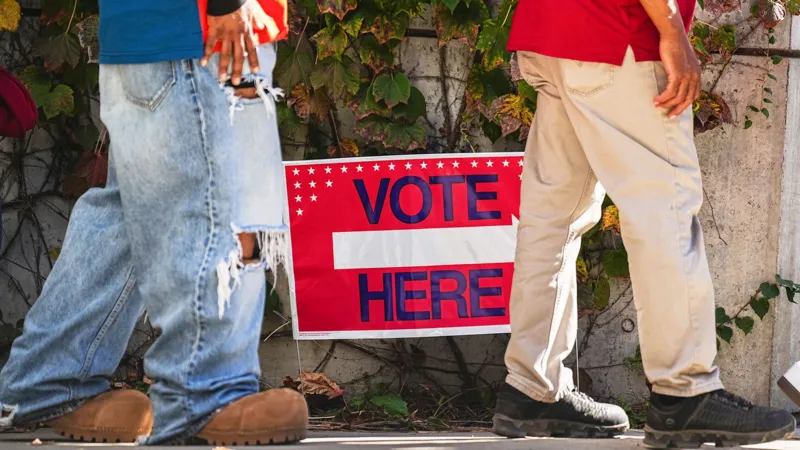
Election day has finally here after months of campaigning and billions of money spent on the US midterm elections.
Democrats seem to be winning, according to the most recent public opinion surveys, but polls haven’t always been accurate, and this year may see some unexpected outcomes.
But in general, when Americans have a voice, there are three probable outcomes.
Here’s a look at what they may be, the potential early indicators when the results are in (which you can follow later on our results page), and the potential implications for the nation.
Quick Fact
| Detail | Information |
|---|---|
| Event | 2026 US Midterm Elections |
| Election Date | November 3, 2026 |
| Location | United States |
| Political Parties | Republican Party and Democratic Party |
| US President | Donald Trump |
| House Seats | All 435 seats |
| Senate Seats | 35 seats |
| Main Focus | Control of the US Congress |
| Key States | Michigan, North Carolina, Minnesota and New Hampshire |
| Election Status | Results and vote counting |
1. A big Democratic wave
Midterm elections often favor the out-of-power party, if history is any indication.
Include what polls indicate is a historically unpopular president, a conflict with Iran that has increased consumer prices, and some contentious policies, such as backing for the development of data centers and strong immigration enforcement.
In addition to gaining control of the House of Representatives, Democrats may easily reach the 218 seats required for a majority. They might flip several seats in more firmly conservative areas in addition to winning the dozen or so contests that electoral observers consider too close to call.
2. A Democratic trickle
Perhaps the polls won’t be totally incorrect, but they won’t be totally accurate either.
In this case, it’s possible that they obtain a majority in the US House elections by taking advantage of enough low-hanging fruit, but it won’t be a substantial one.
This would imply that in order to get enough votes to enact legislation, Democratic leaders in the chamber would frequently need to bargain with their fringe members on the left and the center.
Maybe left-wing candidate Abdul El-Sayed can’t maintain Michigan in the Democratic column, or they can’t defeat obstinately tenacious Republican Senator Susan Collins in Maine.
3. A good night for Republicans
In this scenario, Republicans successfully maintain control of both chambers of Congress.
In order for this to occur, the polls, which have historically overestimated Trump’s popularity, must be inaccurate and Republicans must win the majority of the toss-up elections.
In addition to the surprisingly high turnout of Republican voters, Trump would ultimately need to win over independent and Hispanic voters who had previously appeared to turn against his views.
Republicans Eye Senate Gains
Another possibility is that Republicans win every Senate election in conservative states, including Michigan, a seat that was held by Democrats before to the election.
Republicans may at least make the Democratic contenders sweat, even if they don’t win North Carolina, Democratic-controlled Minnesota, or New Hampshire—races that are barely competitive in this year’s elections.
Reuters On October 20, 2026, Donald Trump grinned on stage at a campaign event in North Carolina while sporting a USA baseball cap.