
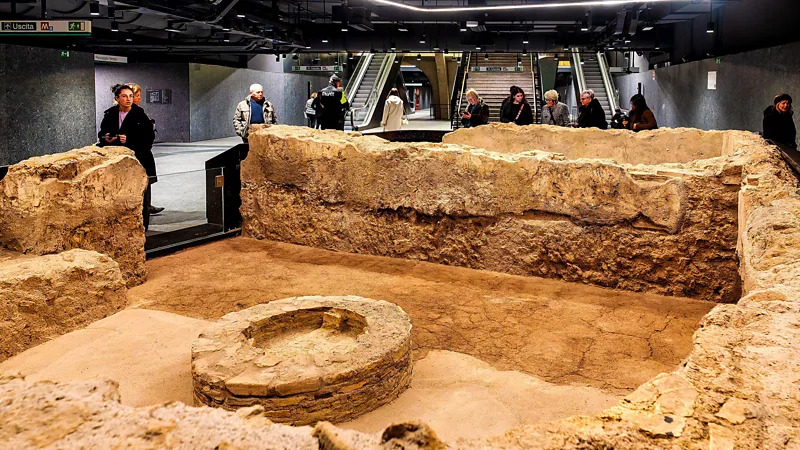
Magnificent Roman remains have been discovered during construction of Rome’s Metro C, and its new “archaeo-stations” are offering tourists a completely new perspective on the city’s ancient past.
I approached the newly opened Colosseo-Fori Imperiali Metro C station on a recent Friday afternoon after navigating the typical lines of tourists crammed into the Colosseum. The people disappeared as I rode the underground escalator. An Escher-like ambiance was produced by four cascades of crisscrossing escalators and metal gridwork. I was still confronting the city’s legendary heritage, though.
A unique problem
Most cities just blast through rock when they construct metro systems. However, engineers have to dig a tunnel through almost 3,000 years of history in Rome, a city renowned for being constructed on the ruins of its past. Workers run the risk of coming across old ruins every time they dig, necessitating laborious excavations. Civic advancement is sluggish, frequently redirected, or put on hold indefinitely.
Due to this particular issue, a metropolis covering 1285 sq km (496 sq miles) was only served by two major metro lines (Metro A and Metro B) until 2014. However, Metro C work has been going on for almost 20 years.
“A project like this could only happen in Rome,” stated Anthony Majanlahti, a historian. “Rome is a city constructed from remnants of its history. It is constructed both on top of and from the cities that came before it. Rome has always required that anything constructed take into account the city underneath it.
It serves as a reminder that Rome is more than its outward appearance.
Metro C’s archaeo-stations are sleek and contemporary, in contrast to the artifacts on display (the train itself is driverless). Illustrated timelines on the walls track your decline as you ride down San Giovanni station’s three escalator cascades.
Metro C wasn't built in a day
December 2025 saw the opening of Metro C’s Porta Metronia station, which is situated between Colosseo-Fori Imperiali and San Giovanni. But there was a twist, much like in many excavation in Rome. During the excavations, archeologists discovered the remnants of a large Roman military barracks from the second century CE, which included a multi-room home with mosaics and paintings.
Because of how significant the find was, engineers rebuilt the station to include the ruins, which were taken out and kept intact while the station was being built.