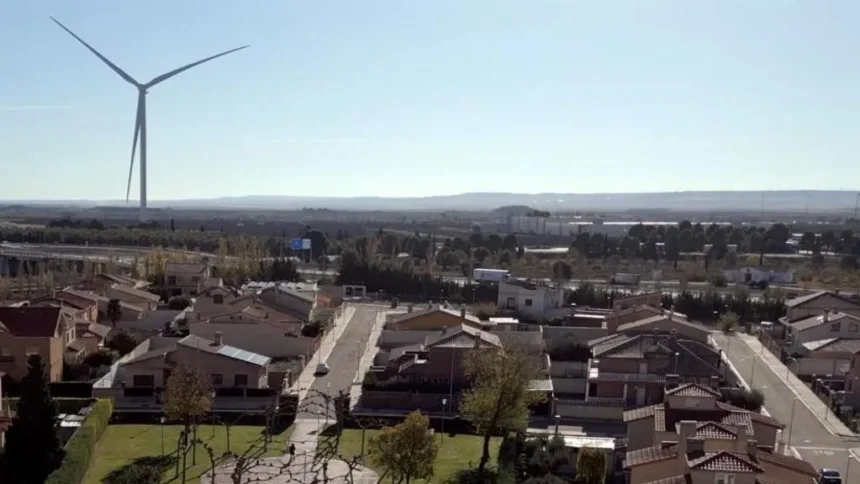
On the outskirts of Figueruelas, a single massive wind turbine spins over the town, a quiet symbol of Spain’s push toward renewable energy. The Aragón region is home to some of the country’s largest wind and solar farms and now hosts the construction of a huge electric vehicle battery factory.
The €4 billion project, funded by Chinese firm CATL and Dutch automaker Stellantis, has been described as one of Europe’s largest Chinese investments. Mayor Luis Bertol Moreno points out that the area’s constant wind and sunny conditions make it ideal for powering the new facility.
Spain has made notable progress in renewables. In 2017, clean energy made up a third of electricity production; last year, it reached 57%. The government aims for 81% by 2030. Prime Minister Pedro Sánchez summed up the vision earlier this year: “Green, baby, green,” highlighting the economic and environmental benefits of renewable energy.
Blackouts and Scrutiny
Despite these gains, Spain’s green ambitions have faced criticism. In April, a nationwide blackout left homes, schools, and transport systems in the dark. The cause remains under investigation, though Red Eléctrica, the national grid operator, and the government insist it was not due to the high share of renewable energy.
Conservative opposition leader Alberto Núñez Feijóo argued that Spain’s reliance on renewables may have contributed to the outage, while pointing out that solar production had hit a record 61.5% just a week earlier.
Red Eléctrica attributed the blackout to a combination of factors, including an “unknown event” and voltage fluctuations, ruling out cyber-attacks.
Nuclear Debate
The blackout has intensified debates over Spain’s nuclear plants. Currently providing around 20% of the country’s electricity, Spain plans to close all five nuclear plants between 2027 and 2035. Industry leaders argue that nuclear energy provides reliable, CO₂-free power 24/7 and should complement renewables.
Ignacio Araluce of Foro Nuclear stresses that “while renewables are crucial, they cannot produce energy around the clock. Nuclear ensures stability year-round.”
Challenges Ahead
Spain also faces challenges in energy storage and grid connectivity, with the Iberian Peninsula relatively isolated from the broader European network. Political instability adds uncertainty, as scandals and a weakened parliamentary majority could trigger elections. A right-wing government might shift focus away from renewables toward traditional energy sources.
Local Impact
For Figueruelas, renewable energy and investment are already reshaping the town. The battery factory will bring thousands of jobs and a significant population increase, revitalizing the local economy. As resident Manuel Martín notes, “These kinds of investments revitalise the area, and the energy is free – it just depends on the sun and the wind.”
Despite political debates and technical hurdles, Spain’s renewable transition continues, offering hope for a cleaner and more sustainable energy future.