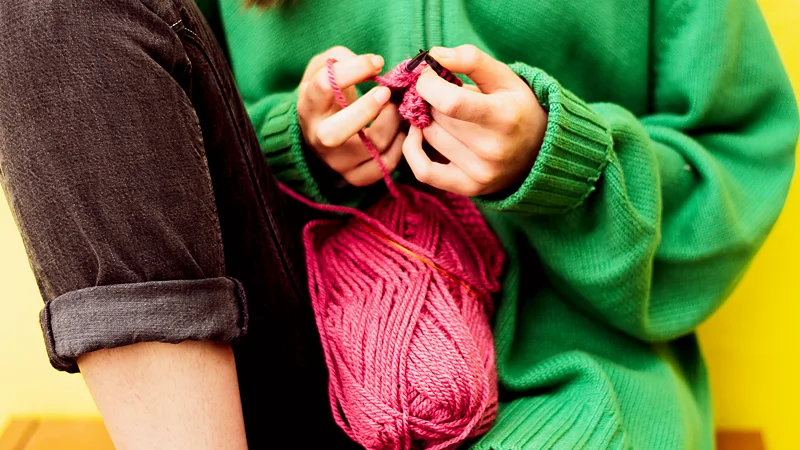
A Simple Hobby With Mental Health Benefits
Knitting is cheap, easy to learn, and widely available. Many people now see it as more than a hobby. Health experts say it may help people manage stress and break unhealthy habits.
Amanda Wilson from Mississauga, Canada struggled with nail biting and skin picking for years. She lives with obsessive compulsive disorder. These habits often caused infections and painful wounds.
Everything changed when she started knitting. Holding yarn and needles gave her hands something productive to do. Over time, her harmful habits faded. Today, she says her nails are healthy and her scalp has healed.
Stories like hers are becoming more common. Many people now use knitting to control habits such as nail biting, doomscrolling, or even smoking.
Growing Interest From Mental Health Experts
For many years, knitting was seen mainly as a pastime for older people. That image is slowly changing. Therapists and researchers are now studying its mental health benefits.
However, scientific research on knitting remains limited. Most studies rely on surveys from people who already knit. In one survey from 2020, about 90 percent of crochet users said the activity helped them feel calmer.
Researchers say stronger clinical studies are still needed. Many existing surveys include mostly women and experienced knitters. This makes it harder to measure the full effect on the wider population.
Even with these limits, early findings are encouraging.
How Knitting Calms the Mind
Psychiatrist Carl Birmingham studied knitting in a treatment center for young women with eating disorders. Patients followed strict recovery routines that often caused anxiety.
Knitting helped many of them relax. Around 75 percent of the participants said knitting reduced their worries about food.
Experts believe the repetitive hand movements play a key role. Knitting requires both hands to work together in a steady rhythm. This movement may activate the parasympathetic nervous system, which helps the body relax after stress.
Some researchers also believe knitting may reduce activity in brain regions linked to fear and stress. These areas include the amygdala and the insula.
Even beginners may benefit. Experts say skill level is less important than the repetitive movement itself.
Knitting as a Tool to Replace Bad Habits
Knitting can also work as habit replacement therapy. This approach replaces harmful behaviors with healthier ones.
For example, some people use knitting instead of smoking. Others use it to avoid scrolling on their phones or picking their skin.
One well known example is Loes Veenstra from the Netherlands. She knitted more than 550 sweaters while trying to quit cigarettes.
Another knitter named Casey spent decades smoking. After many failed attempts to quit, she joined a knitting class. The craft replaced the routine she once associated with smoking.
Whenever she felt the urge to smoke, she picked up her knitting instead. After a few rows, the craving faded. She has now lived more than two years without cigarettes.
Promising Results in Addiction Recovery
Some treatment centers have started using knitting programs for people recovering from substance abuse. Early studies suggest the activity can reduce cigarette use among participants.
Researchers caution that these results are still preliminary. Programs often include health education alongside knitting sessions. This makes it difficult to measure knitting’s exact impact.
Still, many participants say knitting helps them stay calm during withdrawal and stressful situations.
Not a Cure, but a Helpful Tool
Experts stress that knitting is not a medical cure. It will not work for everyone. Some people may find it too difficult or frustrating.
However, it offers a simple way to keep the hands busy and the mind focused. For many people, that small shift can make a big difference.
More clinical research is needed before knitting becomes a standard therapy. Yet early evidence suggests that a pair of needles and a ball of yarn might help people take the first step toward healthier habits.