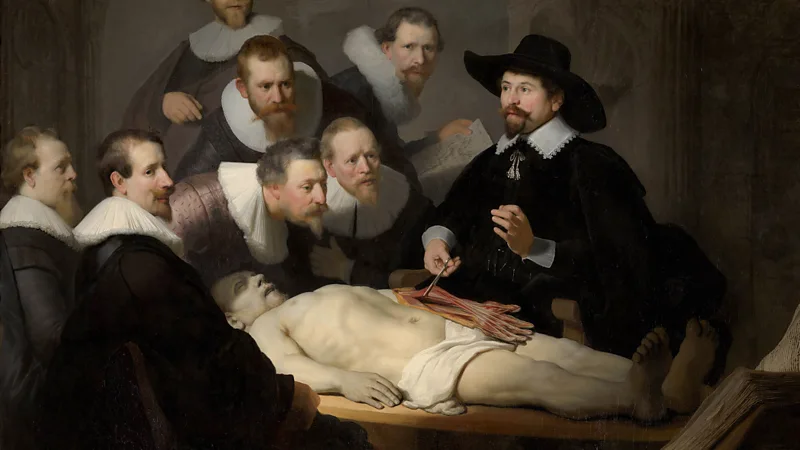
For hundreds of years, artists and doctors used real human bodies to study anatomy. These bodies helped create detailed medical drawings that still influence science and art today. But behind many of these works lies a disturbing truth. Most of the people shown never gave consent, and many came from powerless parts of society.
A new exhibition in Leeds, UK, titled Beneath the Sheets: Anatomy, Art and Power, brings this hidden history into public view. It explores how science advanced through bodies taken from prisoners, the poor, and the forgotten.
Crime, Punishment, and the Human Body
One of the most famous examples appears in Rembrandt’s 1632 painting The Anatomy Lesson of Dr Nicolaes Tulp. At first glance, the figure looks noble and strong. In reality, the man was a criminal executed for stealing a winter coat. Doctors dissected his body in front of an audience as both education and spectacle.
This practice was common at the time. Authorities often handed over the bodies of executed criminals to anatomists. Society treated these people as property even after death.
Anatomy as Public Entertainment
Early medical books relied heavily on illustrations. Surgeons believed drawings mattered as much as text. In the 16th century, Andreas Vesalius changed medical science by drawing anatomy directly from dissected bodies.
The title page of his famous 1543 book shows a woman’s body being cut open before a crowd. She was an executed sex worker. Surgeons dissected her to prove whether she was pregnant, a claim she had made to escape execution. The image shows how power and control shaped early medicine.
Who Could Afford These Books
Most people whose bodies appeared in anatomy books lived in poverty. Meanwhile, the books themselves sold for high prices. Wealthy collectors often displayed them in their homes like fine art.
In the 19th century, color printing made medical atlases even more elaborate. Some copies remain untouched because buyers treated them as status symbols, not working tools.
When Bodies Became Exhibits
Sometimes, doctors turned preserved bodies into public displays. One shocking case involved Mary Billion, who died in 1775. Her husband embalmed her body with help from a respected surgeon. He then dressed her in her wedding gown and displayed her in his dental shop window to attract customers.
This case highlights how little control many women had over their bodies, even after death.
Art, Science, and Moral Questions
Artists like Leonardo da Vinci and Michelangelo studied dissected bodies to improve realism in their work. Medical books often showed bodies posed like classical statues. These images blended beauty with brutality.
The exhibition asks a difficult question: who paid the price for medical progress? The answer often points to society’s most vulnerable.