
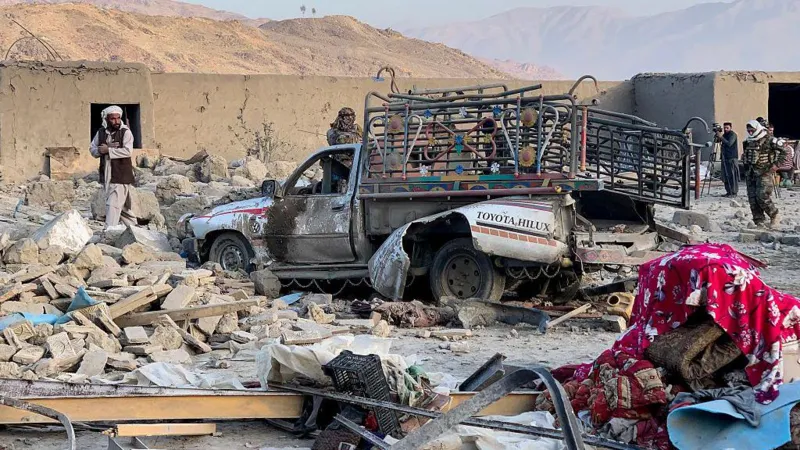
After a series of bombings that occurred in Kabul, tensions have risen between Afghanistan and Pakistan. A powerful explosion shook the District 6 residents’ homes. Fear spread throughout the area as jets flew above.
Pakistan conducted airstrikes in Paktia, Kandahar and Kabul. Kandahar is symbolic because it was the place where the Taliban began. These strikes were a significant escalation of the Afghanistan-Pakistan conflict.
Why the latest violence?
The Taliban claimed that it had launched a ground operation near the border prior to the airstrikes. The Taliban government claimed that their troops had captured and destroyed several Pakistani posts. The action was described as revenge.
Kabul claims that Pakistani troops entered Afghan territory first and massacred civilians including women and kids. According to the Taliban, Pakistan has violated Afghan sovereignty.
Pakistan rejects this claim. Islamabad claimed that it was militants hiding places and not civilians they were targeting. Officials said they targeted bases belonging to the Tehreek e Taliban Pakistan (also known as TTP).
Civilians Casualties and Redisputed Claims
Pakistan conducted airstrikes less than one week prior to the Kabul attack in Nangarhar, and Paktika. According to credible reports from the United Nations, 13 Afghan civilians were killed in these attacks.
Pakistan claims to have solid proof that TTP militants are operating from Afghan territory. Pakistani officials claim that the TTP was responsible for the terrorist attack, despite IS claiming responsibility.
The Taliban government has denied supporting any groups that pose a threat to another country. The Taliban government claims that Pakistani military action is unprovoked.
Mediators who fail to reach a settlement
Last major outbreak was in October 2025. For several days, both sides traded cross-border strikes. Qatar and Turkey intervened to mediate. Doha and Istanbul held talks.
Both governments accuse one another of not pursuing diplomatic solutions.
Military Strategy and Strength
Pakistan’s military has distinct advantages. Pakistan has advanced tanks, fighter jets and defence systems. The Taliban regime in Afghanistan controls the military equipment that was left by foreign and Afghan forces.
Afghanistan does not have the necessary aircraft to carry out deep airstrikes in Pakistan.
However, the Taliban has a long history of guerrilla war. The Taliban fought against US and NATO forces more than twenty years. It used drones in the most recent confrontation to attack Pakistani targets. Drones, which are cheap and simple to use, have changed the face of modern conflict.
Limitation of access to verified information
Independent verification remains difficult. Taliban restrictions on foreign journalist access, particularly in border areas. The Taliban also restrict access to Pakistan’s border regions for foreign journalists.
It is difficult to gauge the real scale of conflict due to the lack of transparency.
The Economic and Human Impact
Since October 20, 2025, the trade between these two nations has been closed. The longest trade halt in recent decades. Afghan businessmen are in a difficult situation. Access to essential goods such as medicines has become more difficult.
Hunger and poverty are already a reality for many Afghans. Many Afghans felt relieved that the war on a large scale had come to an end in 2021.
Now, the Afghanistan-Pakistan conflict threatens regional stability as well as millions of people who seek peace.