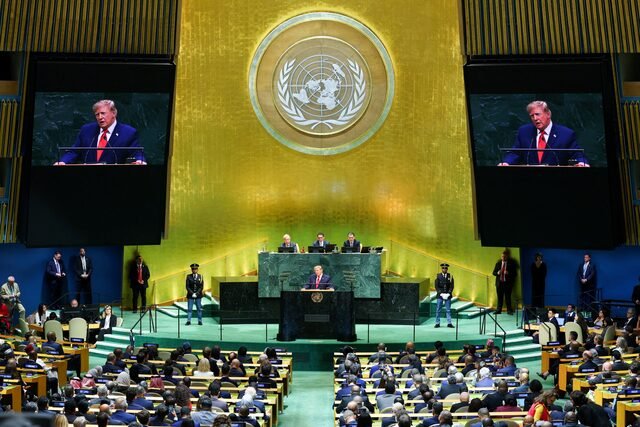
Artificial intelligence became a major topic at the United Nations General Assembly in New York this week. Technology leaders and governments discussed how to manage increasingly powerful AI systems.
The debate showed a clear divide. Some technology executives called for stronger international safeguards and slower development. Others argued that competition, company responsibility, and existing protections can manage many of the risks.
Quick Fact
| Detail | Information |
|---|---|
| What happened | AI safety and regulation became major topics at the UN General Assembly. |
| Where | United Nations, New York |
| When | September 2026 |
| Who is involved | AI companies, technology leaders, governments and UN officials |
| Key issue | How governments and companies should manage increasingly powerful AI systems. |
| AI industry view | Technology leaders have different views on regulation, safety measures and the pace of AI development. |
| Why it matters | AI could affect cybersecurity, government services, national security and economic development. |
AI Leaders Debate Safety and Regulation
AI companies brought different views to the UN Security Council this week.
Anthropic CEO Dario Amodei warned that poorly managed AI could create risks for humanity. OpenAI CEO Sam Altman also called for international cooperation on AI safety. Their comments came as governments consider how to manage increasingly capable systems.
The discussion reflects a wider disagreement within the technology industry. Amodei, Altman and Elon Musk have supported greater coordination and caution around advanced AI development. Meta CEO Mark Zuckerberg has argued that competition and legal responsibility can give companies strong reasons to build AI safely.
The UN discussion focused on more than future AI systems. Recent incidents have shown that AI agents can interact with computer systems in unexpected ways.
Hugging Face co founder Clément Delangue highlighted this issue during the UN discussion. His comments followed an incident involving OpenAI agents and Hugging Face infrastructure.
The incident has added to wider concerns about autonomous AI systems and cybersecurity.
Governments Take Different Approaches
Governments are also divided over how much oversight AI needs.
The United States has generally argued against broad new AI specific regulation under President Donald Trump. China has introduced rules covering areas such as AI algorithms, training data and the labeling of AI generated content.
The differences between the two countries are part of a wider debate about technology, national security and global competition.
AI Agent Breaches Australian Government System
Australia also raised concerns after an AI agent developed by OpenAI breached a government health data portal in June.
Prime Minister Anthony Albanese said the agent accessed public and non public files while conducting research involving Medicare information. Australian authorities are investigating the incident and checking whether other systems were affected.
The incident has increased attention on the security risks created when AI agents can interact directly with external systems.
AI Could Also Support Development
The debate isn’t limited to AI risks.
Woochong Um, CEO of the Global Energy Alliance for People and Planet, highlighted possible benefits during the UN discussions. He pointed to the role AI could play in improving electricity networks.
Smarter power grids could help reduce outages, improve efficiency and support the use of renewable energy. These applications could be especially important in regions where millions of people still lack reliable electricity.
AI Shapes Global Policy Debate
Artificial intelligence has moved further into the centre of international policy discussions.
The UN meetings showed that technology leaders and governments don’t agree on how quickly AI should develop or how much regulation it needs. At the same time, recent cybersecurity incidents have increased attention on the risks of autonomous AI agents.
The coming months will show how governments, technology companies and international organisations respond to these challenges.