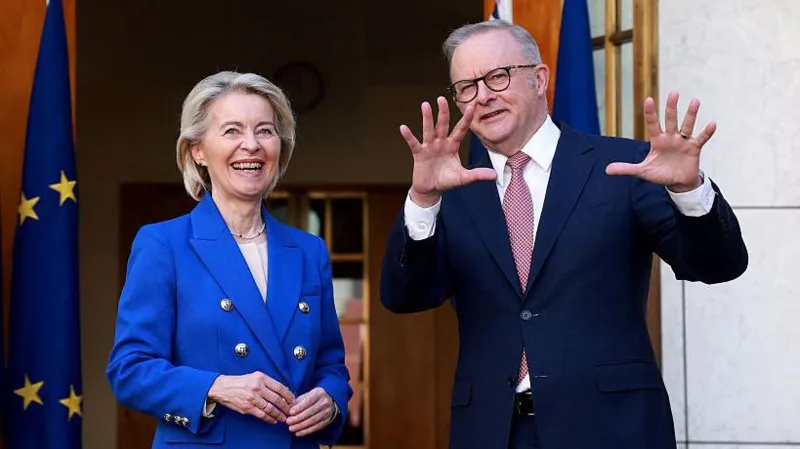
After eight years of negotiation, Australia and the European Union finally reached a free-trade agreement. Signed in Canberra, the deal is worth around A$10billion.
Anthony Albanese, Ursula von der Leyen and others have both hailed the deal as a success for both parties.
Von der Leyen stated that the agreement focuses on trust and long-term stability, particularly at a moment when global trade tensions are increasing and risks to supply chains are growing.
Tariff cuts and cheaper goods for consumers
This agreement eliminates nearly all of the tariffs for Australian exports into Europe. The EU will be able to import more products, including wine, seafood, and wheat.
Australians will also benefit from cheaper prices for European products such as pasta, cookies, chocolates and spirit.
Disputes Over Meat Exports
The deal is a success overall, but it has caused concern for farmers.
Over the next ten years, Australian beef exports will increase significantly to the EU. Australian farmers, however, had sought a higher cap.
Fearing that a stronger local competition would hurt the agriculture, they oppose this increase. Farmers in Europe are already warning about increasing pressures from trade agreements.
The Right to Name Foods Remains Sensitive
This agreement covers the naming of food products.
Australian producers are still allowed to use local terms such as parmesan. Some names may be restricted on export markets. Exports of prosecco, for example, will gradually be eliminated over the next ten years.
The European Union has long been concerned about the protection of regional food identity.
Stronger Defence and Mineral Cooperation
The agreement expands the cooperation between defence and security. The two sides will work together on counterterrorism, maritime security, space technology, and other areas.
This agreement strengthens the collaboration in critical mineral areas such as lithium, tungsten and other minerals. These minerals are vital for the modern industry, which includes clean energy technology and other industries.
The Strategic Role in an Changing Environment
The EU is looking to diversify global partnerships. Geopolitical shifts and uncertainty in trade have led countries to be less reliant on the single market.
Donald Trump’s recent moves on tariffs, supply chains and other issues have increased global uncertainty. China’s control of key minerals is a concern for many countries.
The EU wants to create a stable, resilient and more reliable trade network by strengthening its ties with Australia.