
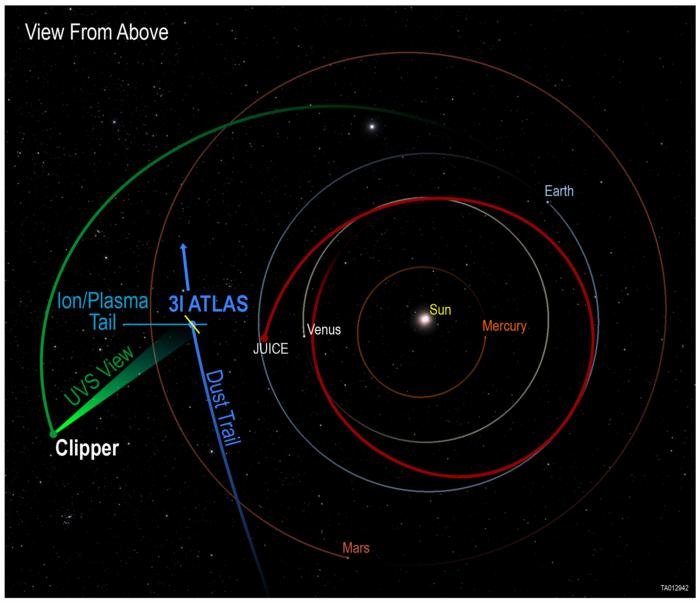
NASA’s Europa Clipper spacecraft has captured important data on the interstellar comet 3I/ATLAS. In July, it became the third officially recognised interstellar object to enter our Solar System.
The UVS instrument on Europa Clipper had a rare view of the comet at a time when Earth and Mars observations were limited or impossible.
“We’re excited this unexpected opportunity allowed us to view another target on the way to Jupiter,” said Dr Kurt Retherford of Southwest Research Institute, principal investigator for Europa-UVS. “These observations provide a unique and detailed view of 3I/ATLAS.”
What makes Europa Clipper’s observations unique?
Within a week of the comet’s discovery, analysts at NASA’s Jet Propulsion Laboratory tracked its trajectory through the Solar System. The Europa Clipper team realised the spacecraft could observe 3I/ATLAS in November, when Earth-based observations were blocked by the Sun, but Mars-based views were possible.
Europa Clipper filled the observational gap between late September Mars-based views and later Earth-based monitoring. The comet’s path placed the spacecraft between it and the Sun, offering a rare vantage point. Comets have a dust tail trailing behind and a plasma tail pointing away from the Sun.
A new perspective on the comet’s tails
Europa-UVS’s sunward viewpoint allowed the team to observe the comet’s tails from behind, looking back toward the nucleus and coma. Meanwhile, the UVS instrument aboard ESA’s JUICE mission provides a more typical anti-sunward view at the same time.
Dr Thomas Greathouse, co-deputy principal investigator of Europa-UVS, said, “Combining these observations with Earth-based data will help us understand the tails’ shapes and behaviour more fully.”
Discovering the comet’s composition
Europa-UVS detected oxygen, hydrogen, and dust features. These findings support previous data indicating 3I/ATLAS experienced high outgassing after passing closest to the Sun.
“Europa-UVS excels at measuring atomic and molecular transitions,” said Retherford. “We can observe gases emitted by the comet and see water molecules split into hydrogen and oxygen atoms.” This allows precise analysis of the comet’s processes and composition.
Why these observations matter
Dr Tracy Becker, co-deputy principal investigator of Europa-UVS, explained, “Studying the comet’s composition and gas emissions helps us trace its origin and evolution as it traveled from another star system into our Solar System.”
She added, “We want to understand the chemical processes at play. Were they similar to the processes that formed our Solar System? Answering these questions sheds light on how interstellar objects form and evolve.”