The Desert Stopover as a Global Hub
Dubai began as an overnight stopover for flying boats travelling from the UK towards India and Australia. In the 1960s its desert runway served primarily as a refueling area. Dubai International Airport is a global landmark. By 2024, more than 92 millions passengers will have passed through the airport’s halls. This is higher than London Heathrow, which had 83.
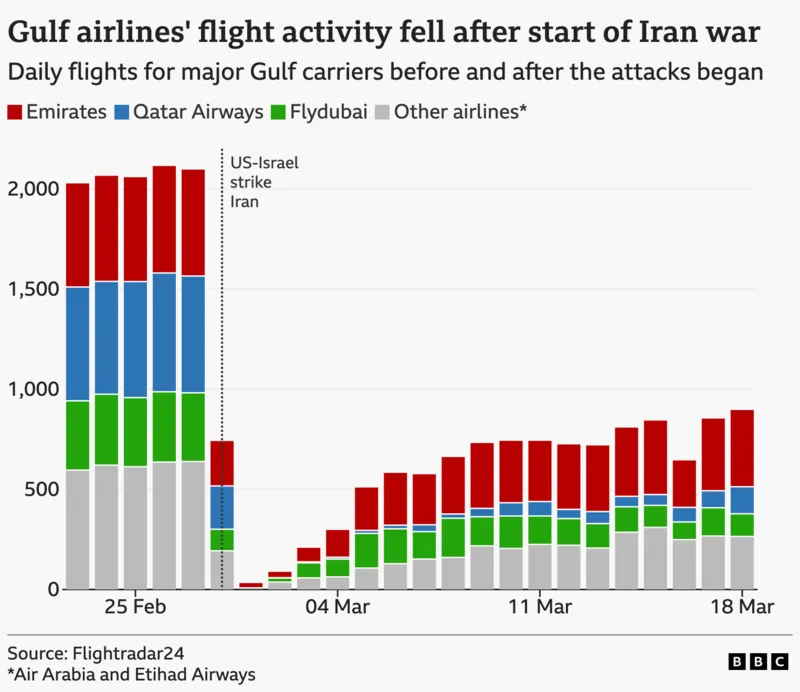
Qatar and the UAE also host major hubs. Abu Dhabi and Doha handled approximately 87 millions passengers together last year. These airports are usually able to manage more than 3,000 flights per day, mostly operated by Emirates and Qatar Airways.
Airspace and fuel disruptions
Aviation industry has been hit hard by the ongoing conflict in the Middle East. The closure of airspace left thousands of planes grounded, and thousands more passengers stranded. Iran’s blocking of the Strait of Hormuz led to jet fuel shortages. Fuel prices in Europe have increased by about 50%, largely due to the Gulf, which supplies half of Europe’s fuel.
Chaos at the Airport
First US-Israeli attacks on Iran, in February of this year, caused widespread disruption. Some aircraft in flight had to return.
The government and the airlines were scrambling to react. Qatar Airways, Etihad, Emirates, and other airlines resumed some limited flights. Several countries also chartered aircraft to transport their citizens.
Traveler Confidence is at Risk
Gulf hubs are being reconsidered by many passengers. Ian Scott had to return to Melbourne via Doha and spend days in the desert before he could catch a new flight. The man says that he avoids Gulf flights, for fear of further instability.
It is a concern for hubs. In these airports, more than half the travelers only use them to connect with other flights and do not stay in city. Dubai has 47% connecting passengers, while Abu Dhabi is 54% and Doha 74%.
Gulf Aviation Model
Gulf’s model combines point-topoint comfort with efficiency. The model allows travelers to go from Boston to Bali, or Amsterdam to Antananarivo in one stop. This model is heavily dependent on the geography of the area and its reputation for smooth and reliable connections. Now, disruption threatens to undermine this unique advantage.