
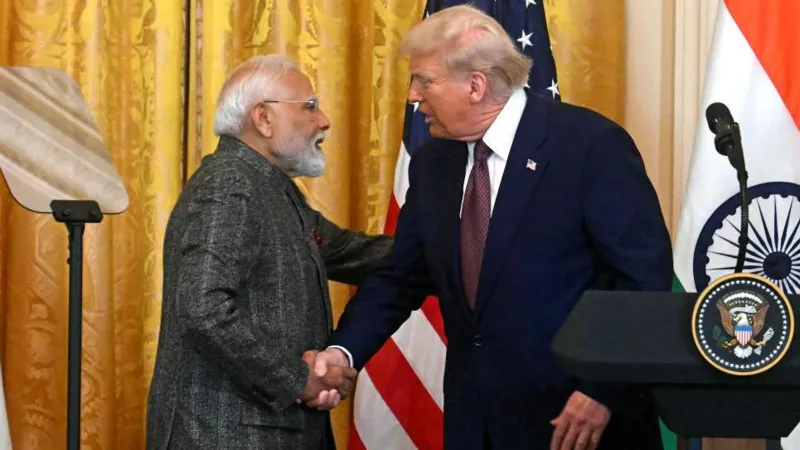
India and the United States have taken a major step toward easing trade tensions after months of strain. US President Donald Trump announced a sharp cut in tariffs on Indian goods, lowering them from fifty percent to eighteen percent. The move has brought relief to Indian markets, though many details of the agreement remain unclear.
The decision follows a phone call between Trump and Indian Prime Minister Narendra Modi. While Trump described the move as a breakthrough, Indian officials have stayed cautious and avoided confirming several claims made by the US president.
Tariff Cut Brings Relief to Indian Economy
Last year, the US raised tariffs on Indian imports to record levels. The decision hit sectors like textiles, seafood, and jewellery hard. These industries employ millions of workers across India.
The high duties also weakened the rupee and pushed foreign investors to pull money out of the country. With tariffs now reduced to eighteen percent, India stands closer to other Asian exporters such as Vietnam and Thailand.
Market experts say the announcement has removed major uncertainty from India’s financial system. Investors see the move as a short term positive signal, even without full clarity.
India Gains Edge as Supply Chains Shift
Economists believe the lower tariffs improve India’s position as an alternative manufacturing hub to China. India already offers low labor costs, political stability, and a large domestic market.
These factors make the country attractive to multinational firms looking to spread risk across regions. Analysts say the new tariff rate strengthens India’s role in global supply chain restructuring.
Textile exporters also welcomed the announcement. Industry groups say it will help Indian apparel compete better in the US market, which remains their largest export destination.
Trade Deal Details Still Unclear
Despite the optimism, trade experts urge caution. The US has not released any official agreement text. There is no clarity on product coverage, timelines, or enforcement rules.
Trump claimed that India agreed to stop buying Russian oil and increase purchases from the US. Indian officials have not confirmed this. Agriculture also remains a sensitive issue, as millions of Indians depend on farming for income.
US officials say the deal could open India’s market to more American farm products. Delhi has not responded publicly, signaling that negotiations may still be ongoing.
Strategic Impact Beyond Trade
The announcement carries strong geopolitical weight. Over the past year, India strengthened ties with China and Russia after US tariffs disrupted relations.
Leaders from India, China, and Russia displayed growing unity at recent regional summits. Analysts say the renewed engagement with Washington could shift India closer to the US again.
Still, India prefers strategic balance. Experts believe Delhi will move carefully and avoid sudden alignment changes unless the trade partnership proves stable.
A First Step, Not the Final Deal
Policy groups describe the tariff cut as a starting point rather than a completed agreement. Both governments expect more talks in the coming months.
Until a joint statement or signed document appears, analysts say the announcement should be seen as a political signal. Celebration, they warn, should wait for confirmed outcomes.